
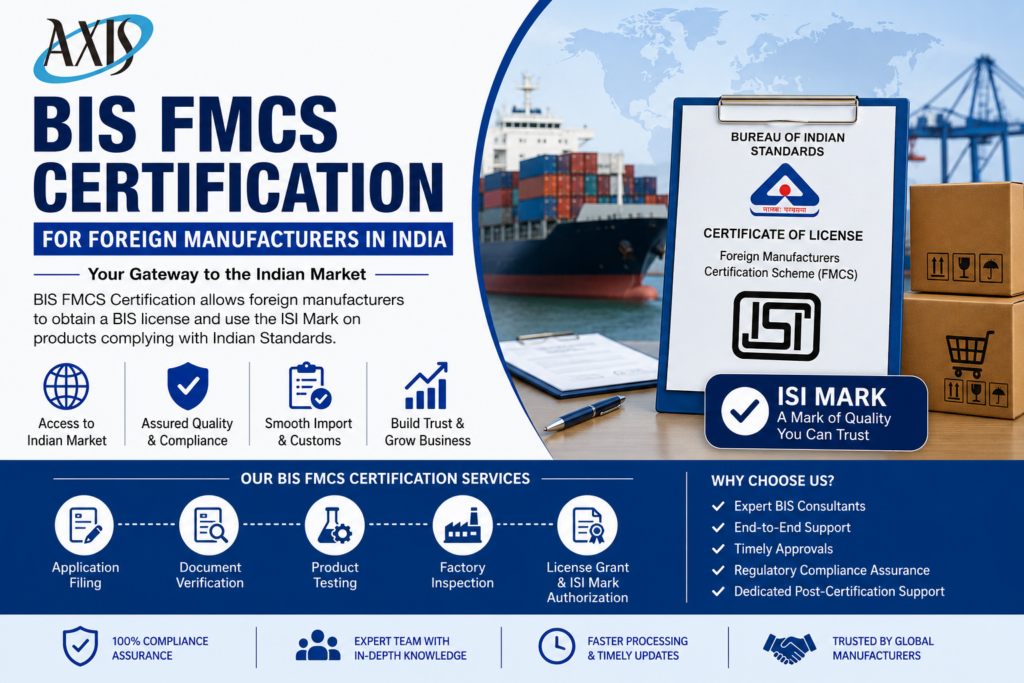
India is one of the largest consumer markets in the world, attracting manufacturers from across the globe. However, many products imported into India must comply with strict quality and safety regulations established by the Bureau of Indian Standards (BIS). For overseas manufacturers, obtaining BIS FMCS Certification for Foreign Manufacturers in India is often a mandatory requirement before products can be sold in the Indian market.
The BIS FMCS Certification for Foreign Manufacturers in India is governed under the Foreign Manufacturers Certification Scheme (FMCS), which enables manufacturers located outside India to obtain a BIS license and use the ISI mark on approved products. This certification confirms that imported products meet Indian quality standards and regulatory requirements.
Understanding BIS FMCS Certification
The BIS FMCS Certification for Foreign Manufacturers in India allows overseas production facilities to demonstrate compliance with relevant Indian Standards. Through this scheme, foreign manufacturers can legally export products that fall under mandatory certification requirements.
When your certification journey is completed, your product will be tested in BIS-authorized facilities. Afterward, the BIS inspectors inspect the manufacturing facilities before ultimately approving the product for BIS certification. When it gets approved, a manufacturer gets a license to use the ISI mark as a testament to quality.
Why Foreign Manufacturers Need FMCS Certification
Obtaining BIS FMCS Certification for Foreign Manufacturers in India provides several business advantages:
- Access to the Indian market.
- Improved product credibility.
- Compliance with Indian import regulations.
- Reduced customs and regulatory issues.
- Increased confidence among distributors and buyers.
- Enhanced brand reputation.
For products covered under mandatory regulations, certification is not optional—it is a legal requirement.
Key Benefits of BIS FMCS Registration
The BIS FMCS Registration process offers long-term benefits for overseas businesses:
Regulatory Compliance
Manufacturers can ensure adherence to BIS Standards Compliance and Indian safety regulations.
Market Expansion
Certified products gain easier entry into India’s growing consumer and industrial sectors.
Quality Recognition
The ISI mark demonstrates compliance with recognized quality standards.
Competitive Advantage
Products carrying certification often gain greater acceptance among Indian importers and customers.
Products Requiring BIS Certification
A wide range of products may require BIS FMCS Certification for Foreign Manufacturers in India, including:
- Steel products
- Cement materials
- Household appliances
- Electrical equipment
- Automotive components
- Chemicals
- Industrial products
- Consumer goods
Manufacturers should review applicable standards before exporting products to India.
BIS FMCS Process India
The BIS FMCS Process India generally consists of the following stages:
Application Filing
Manufacturers submit the required application forms and supporting documents.
Technical Assessment
BIS reviews product specifications and compliance documentation.
Product Testing
Samples are tested at approved laboratories to verify conformity with Indian Standards.
Factory Audit
BIS officials inspect the overseas manufacturing facility to evaluate production controls, testing systems, and quality assurance procedures.
License Grant
After successful evaluation, BIS issues certification and authorizes ISI marking.
Completing these stages successfully is essential for obtaining BIS FMCS Certification for Foreign Manufacturers in India.
Documentation Requirements
Foreign manufacturers typically need to provide:
- Company registration documents
- Manufacturing licenses
- Product specifications
- Quality management records
- Laboratory test reports
- Production process details
- Trademark certificates
- Authorized Indian Representative information
Accurate documentation is critical for a smooth approval process.
Importance of an Authorized Indian Representative
You, the foreign manufacturer, need to designate an Authorized Indian Representative (AIR). He would be the point of contact between you (the manufacturer) and the Indian regulatory body for all aspects of BIS certification.
This representative plays an important role in maintaining compliance and supporting certification renewals.
How Indiaxis Supports Foreign Manufacturers
Indiaxis offers comprehensive support for BIS FMCS Certification for Foreign Manufacturers in India. Their team assists clients with application preparation, document verification, testing coordination, audit readiness, and regulatory compliance management.
By leveraging professional expertise, manufacturers can navigate complex certification requirements more efficiently and improve approval timelines.
Common Challenges During Certification
Foreign manufacturers often encounter challenges such as:
- Limited understanding of Indian standards.
- Documentation errors.
- Product testing delays.
- Factory audit preparation.
- Regulatory communication barriers.
Professional BIS Registration Consultant services help businesses overcome these obstacles and streamline certification activities.
Choosing a BIS FMCS Consultant India
A reliable BIS FMCS Consultant India can help manufacturers:
- Interpret regulatory requirements.
- Prepare technical documentation.
- Coordinate laboratory testing.
- Manage factory inspections.
- Ensure compliance throughout the certification process.
With expert support, obtaining BIS FMCS Certification for Foreign Manufacturers in India becomes faster and more efficient.
Conclusion
The BIS FMCS Certification for Foreign Manufacturers in India is a critical compliance requirement for overseas businesses seeking access to the Indian market. Through proper planning, testing, documentation, and factory audits, manufacturers can obtain certification and establish a strong presence in India. Whether pursuing Foreign Manufacturers Certification Scheme approval, BIS Product Certification India, or Mandatory BIS Certification India, FMCS certification is the foundation for successful import and distribution operations.
FAQs
1. What is FMCS under BIS?
FMCS stands for Foreign Manufacturers Certification Scheme, which allows overseas manufacturers to obtain BIS certification.
2. Is BIS certification mandatory for imported products?
Many products notified by the government require mandatory BIS certification before import.
3. What is the purpose of the ISI mark?
The ISI mark indicates that a product complies with applicable Indian Standards.
4. Do foreign factories undergo BIS inspections?
Yes, BIS officials conduct audits of overseas manufacturing facilities.
5. Who can apply for BIS FMCS Certification?
Any foreign manufacturer producing products covered under mandatory BIS standards can apply.
6. Why is an AIR required?
The Authorized Indian Representative serves as the official contact between BIS and the foreign manufacturer.
7. Can a consultant help with FMCS certification?
Yes, experienced consultants assist with documentation, testing, audits, and regulatory compliance.