
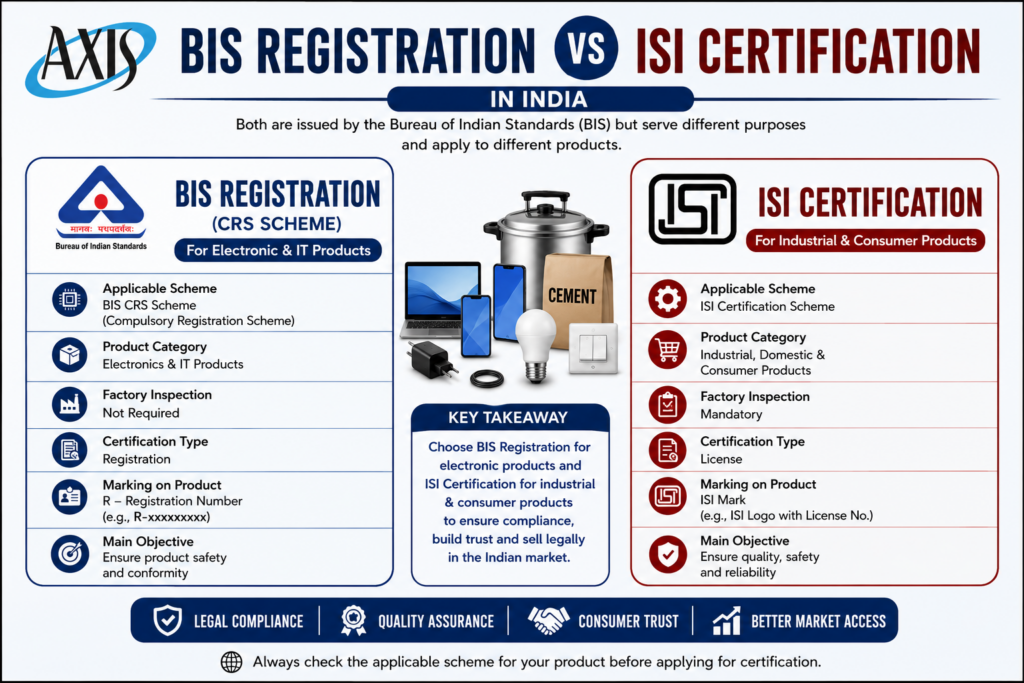
For manufacturers, importers, and brand owners, understanding BIS Registration vs ISI Certification in India is crucial before launching products in the Indian market. Both certifications are issued by the Bureau of Indian Standards (BIS), but they apply to different product categories and follow distinct approval procedures.
India’s product quality regulations have become increasingly stringent to ensure consumer safety and product reliability. Therefore, businesses must determine whether they require BIS CRS Registration or ISI Mark Certification before distributing products in India.
Companies seeking compliance support often rely on industry experts such as Indiaxis to navigate the certification process and ensure regulatory adherence.
Understanding BIS Registration
BIS Registration India generally refers to certification under the BIS CRS Scheme. Introduced by the Ministry of Electronics and Information Technology (MeitY), this scheme covers various electronic and IT products.
Manufacturers must:
- Test products in BIS-approved laboratories
- Meet applicable Indian standards
- Submit technical documentation
- Obtain BIS authorization before sale
The objective is to ensure product safety and conformity with established regulations.
Understanding ISI Certification
ISI Certification India is a product certification system that allows manufacturers to use the ISI mark on products that comply with relevant Indian Standards.
An ISI Mark License demonstrates that a product has undergone rigorous testing and quality evaluation. Many consumer and industrial products require ISI certification before entering the market.
The ISI mark serves as a symbol of trust, quality, and compliance.
BIS Registration vs ISI Certification in India: Core Differences
When comparing BIS Registration vs ISI Certification in India, several differences become evident.
1. Product Coverage
BIS Registration generally applies to:
- Mobile phones
- Laptops
- LED lighting products
- Power adapters
- Electronic accessories
ISI Certification applies to:
- Cement
- Steel products
- Electrical switches
- Household appliances
- Pressure cookers
2. Certification Type
Under BIS Registration vs ISI Certification in India, CRS provides registration, while ISI provides a manufacturing license.
3. Factory Inspection
A major distinction in BIS Registration vs ISI Certification in India is factory inspection.
- CRS Registration: Usually no factory inspection.
- ISI Certification: Mandatory factory inspection.
4. Product Marking
Under the CRS scheme, products display registration details. Under ISI certification, manufacturers must display the recognized ISI mark.
Benefits of BIS Compliance
Whether businesses pursue BIS Registration vs ISI Certification in India, compliance offers several advantages:
- Legal authorization for product sales
- Improved brand reputation
- Enhanced customer confidence
- Reduced regulatory risks
- Better market competitiveness
- Improved product quality standards
Today, BIS Compliance India is considered essential for sustainable business growth.
Products Requiring BIS Registration
Products commonly covered under Mandatory BIS Registration include:
- LED bulbs
- Mobile phones
- Smart televisions
- Wireless keyboards
- Power banks
- USB devices
- Computer equipment
These products must obtain BIS CRS Registration before entering the Indian market.
Products Requiring ISI Certification
Products requiring ISI Mark Certification include:
- Packaged drinking water
- Cement
- Electrical cables
- Household electrical goods
- Kitchen appliances
- Industrial materials
Obtaining an ISI Mark for Manufacturers demonstrates adherence to national quality requirements.
BIS Registration Process
The BIS Approval Process for CRS products typically includes:
Step 1: Product Testing
Testing is conducted in BIS-recognized laboratories.
Step 2: Documentation
Manufacturers prepare technical and compliance documents.
Step 3: Application Filing
The application is submitted online.
Step 4: Verification
BIS reviews the submitted documents.
Step 5: Registration Grant
Upon approval, registration is issued.
This process supports effective Product Testing and Certification.
ISI Certification Process
The ISI certification process generally includes:
- Product testing
- Factory inspection
- Quality management evaluation
- Sample verification
- License approval
- Ongoing surveillance
Compared to CRS, ISI certification is often more comprehensive.
Why Professional Guidance Matters
Navigating BIS Registration vs ISI Certification in India can be challenging due to technical documentation and regulatory requirements.
An experienced BIS Registration Consultant or ISI Certification Consultant can assist with:
- Product classification
- Standard identification
- Laboratory coordination
- Application filing
- Compliance management
- Faster approvals
Professional support significantly improves efficiency and reduces compliance risks.
Conclusion
Understanding BIS Registration vs ISI Certification in India helps businesses identify the correct regulatory pathway for their products. While BIS CRS Registration focuses primarily on electronics and IT equipment, ISI Mark Certification covers a wide range of industrial and consumer goods.
Selecting the appropriate certification ensures compliance with BIS Standards India, enhances market credibility, and supports long-term business growth. Businesses planning to sell products in India should carefully evaluate certification requirements and seek professional guidance whenever necessary.
FAQs
1. What is BIS Registration?
BIS Registration is a certification process under the CRS scheme for specified electronic and IT products.
2. What is ISI Certification?
ISI Certification is a licensing scheme allowing manufacturers to use the ISI mark on approved products.
3. Which products require BIS CRS Registration?
Products such as mobile phones, LED lights, laptops, and power banks commonly require CRS registration.
4. Is factory inspection mandatory for BIS Registration?
Generally, factory inspection is not required under CRS registration.
5. Why is ISI Certification important?
It demonstrates compliance with Indian quality and safety standards.
6. Can foreign manufacturers obtain BIS certification?
Yes, foreign manufacturers can apply for both CRS and ISI certifications when applicable.
7. Should I hire a BIS Registration Consultant?
A consultant can simplify documentation, testing, compliance management, and approval procedures.