
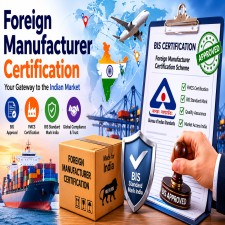
India has become one of the most attractive destinations for international manufacturers due to its expanding consumer base, growing industrial demand, and strong economic development. However, foreign businesses planning to export products to India must comply with Indian regulatory standards before entering the market. One of the most important compliance requirements is Foreign Manufacturer Certification under BIS regulations.
For overseas manufacturers, certification is more than just a legal obligation. It is a gateway to market acceptance, consumer trust, and uninterrupted product distribution across India.
Indiaxis helps global manufacturers understand Indian compliance requirements and manage the certification process efficiently.
What is Foreign Manufacturer Certification?
Foreign Manufacturer Certification refers to the BIS approval process that allows overseas manufacturers to export and sell regulated products in India legally. Once certified, manufacturers can use the BIS Standard Mark India on approved products.
This certification is granted under the Foreign Manufacturers Certification Scheme (FMCS), which enables foreign factories to receive BIS licenses directly from Indian authorities.
The certification confirms that imported products comply with Indian quality, performance, and safety standards.
Why FMCS Certification in India is Important
India maintains strict product quality regulations to ensure consumer protection and product reliability. Therefore, obtaining FMCS Certification in India is mandatory for many imported products.
Benefits of certification include:
- Legal import approval
- Faster customs processing
- Improved customer trust
- Enhanced distributor confidence
- Stronger market positioning
Without proper certification, companies may face:
- Product seizures
- Import restrictions
- Financial penalties
- Shipment delays
As a result, Foreign Manufacturer Certification has become essential for global manufacturers targeting Indian consumers.
Understanding BIS FMCS Certification
BIS FMCS Certification is specifically designed for foreign manufacturing units that export products to India. The scheme ensures that imported goods meet the same standards applied to Indian manufacturers.
The certification process involves:
- Product testing
- Factory inspection
- Documentation verification
- Quality management assessment
Once approved, manufacturers receive permission to apply the BIS Standard Mark India on certified products.
This mark increases product credibility and demonstrates compliance with Indian regulations.
Products Covered Under Foreign Manufacturers Certification Scheme
The Foreign Manufacturers Certification Scheme applies to multiple industries and product categories.
Examples include:
- Electrical equipment
- Consumer electronics
- Industrial machinery
- Steel products
- Chemicals
- Automotive components
- Household appliances
Manufacturers must identify whether their products fall under mandatory BIS certification before exporting to India.
FMCS Approval Process Explained
The FMCS Approval Process requires careful documentation, technical evaluation, and regulatory coordination.
Step 1: Product Standard Identification
Manufacturers determine the applicable Indian Standard (IS) for their product.
Step 2: Technical Documentation
The company prepares:
- Manufacturing process details
- Product specifications
- Quality assurance records
- Factory licenses
- Existing certifications
Step 3: Product Testing
Samples are tested in BIS-recognized laboratories to verify compliance.
Step 4: Application Filing
The manufacturer submits the application under FMCS Registration India procedures.
Step 5: Factory Audit
BIS officials inspect the overseas manufacturing facility to evaluate quality systems and production capabilities.
Step 6: Certification Grant
After successful inspection and approval, BIS issues the license.
The complete Foreign Manufacturer Certification process requires precision and regulatory expertise.
Role of BIS FMCS Consultant
Foreign businesses often struggle with Indian compliance procedures due to technical documentation requirements and changing regulations. A professional BIS FMCS Consultant simplifies the process significantly.
Consultants help with:
- Product category analysis
- Technical documentation
- BIS application filing
- Laboratory coordination
- Audit preparation
- Compliance management
- License renewal
Indiaxis provides end-to-end support for global exporters seeking certification approvals in India.
Importance of BIS Certification India
Obtaining BIS Certification India is a critical step for businesses aiming to build a long-term presence in the Indian market.
Certification provides:
- Legal product authorization
- Brand credibility
- Consumer confidence
- Reduced regulatory risk
- Better business opportunities
Products with the BIS mark are often preferred by distributors, retailers, and customers because they meet recognized quality standards.
For many industries, certification is mandatory under Indian law.
BIS Standard Mark India and Consumer Confidence
The BIS Standard Mark India serves as proof that products comply with Indian technical standards.
Advantages of the BIS mark include:
- Increased product trust
- Enhanced brand value
- Better market recognition
- Stronger retail acceptance
For foreign manufacturers, the mark demonstrates commitment to quality and safety.
This is one reason why Foreign Manufacturer Certification is becoming increasingly important in international trade.
Common Challenges Faced by Foreign Manufacturers
1. Understanding Indian Standards
International standards may differ from Indian regulatory requirements.
2. Complex Documentation
Missing or incorrect paperwork can delay approvals.
3. Product Testing Failures
Technical non-compliance may require product modifications.
4. Audit Preparation
Manufacturing facilities must maintain strong quality control systems.
5. Delayed Coordination
Cross-border communication and regulatory procedures may increase timelines.
Working with experienced professionals can help manufacturers overcome these challenges effectively.
How to Speed Up FMCS Registration India
Manufacturers can improve approval efficiency by:
- Identifying applicable standards early
- Preparing complete documentation
- Conducting pre-compliance testing
- Maintaining quality records
- Working with experienced consultants
These steps help reduce delays in the FMCS Approval Process and improve approval success rates.
Conclusion
India offers tremendous opportunities for international manufacturers, but regulatory compliance remains a critical requirement for successful market entry. Obtaining Foreign Manufacturer Certification through the FMCS route ensures products meet Indian quality and safety standards while strengthening customer confidence.
From technical documentation and testing to factory inspections and licensing, the certification process requires careful planning and expertise. Businesses that secure FMCS Certification in India gain smoother market access and long-term business credibility.
With professional support from Indiaxis, foreign manufacturers can manage compliance requirements efficiently and expand successfully into the Indian market.
FAQs on Foreign Manufacturer Certification
1. What is Foreign Manufacturer Certification?
It is a BIS approval process allowing foreign manufacturers to sell regulated products in India.
2. What is FMCS Certification in India?
FMCS Certification in India is a BIS certification scheme for overseas manufacturing units.
3. Why is BIS FMCS Certification required?
It ensures imported products comply with Indian safety and quality standards.
4. What is the Foreign Manufacturers Certification Scheme?
It is a BIS framework that allows foreign manufacturers to obtain Indian certification licenses.
5. What is included in the FMCS Approval Process?
The process includes product testing, documentation review, factory inspection, and license approval.
6. Why is the BIS Standard Mark India important?
It confirms compliance with Indian standards and builds customer trust.
7. Can a BIS FMCS Consultant help with approvals?
Yes, consultants assist with technical compliance, documentation, and BIS coordination.
8. What products require BIS Certification India?
Various electrical, electronic, industrial, and consumer products require mandatory BIS approval.