
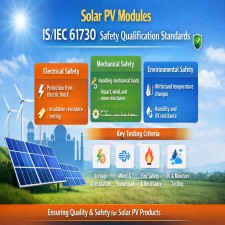
India’s renewable energy sector is expanding rapidly, and solar energy is at the forefront of this transformation. To ensure safety, performance, and reliability, the Indian government mandates strict compliance standards. One of the most crucial standards is Solar PV Modules IS/IEC 61730, which governs the safety requirements for photovoltaic modules.
In this blog, we will explore the importance of Solar PV Modules IS/IEC 61730, its role in BIS certification, testing procedures, and compliance requirements in India, with reference insights inspired by Indiaxis.
What is Solar PV Modules IS/IEC 61730?
Solar PV Modules IS/IEC 61730 is an Indian adoption of the international IEC standard that specifies safety qualifications for photovoltaic modules. It ensures that solar panels are safe for long-term use under various environmental conditions.
The standard focuses on:
- Electrical safety
- Fire resistance
- Mechanical durability
- Environmental reliability
The updated version, IS IEC 61730 2023, introduces stricter norms to align with global safety practices and evolving solar technologies.
Importance of BIS Guidelines for Solar PV Modules
The BIS Guidelines for Solar PV Modules are essential for regulating the quality of solar products in India. Under these guidelines, manufacturers must comply with Solar PV Modules IS/IEC 61730 to obtain certification.
These guidelines ensure:
- Consumer safety
- Product reliability
- Standardized manufacturing practices
- Prevention of substandard imports
As highlighted in industry insights similar to Indiaxis, compliance with these standards is not just regulatory but also enhances market credibility.
BIS Certification for Solar PV Modules
To sell solar panels in India, manufacturers must obtain BIS certification for solar PV modules. This certification confirms that the product meets the requirements of Solar PV Modules IS/IEC 61730.
Key Steps in Certification:
- Application submission to BIS
- Product testing in BIS-approved labs
- Factory inspection
- Grant of license
The certification is mandatory under government regulations, especially for products covered under solar-related quality control orders.
Solar PV Module Testing Requirements
Compliance with Solar PV Modules IS/IEC 61730 involves rigorous testing procedures. These tests ensure the safety and durability of modules under real-world conditions.
Major Testing Parameters:
- Insulation resistance testing
- Temperature cycling
- Humidity freeze testing
- Mechanical load testing
- Fire resistance checks
These solar PV module testing requirements are crucial to verify that panels can withstand harsh environmental conditions over time.
IS IEC 61730 Transition Guidelines
With the introduction of IS IEC 61730 2023, manufacturers must follow updated IS IEC 61730 transition guidelines.
Key Transition Points:
- Migration from older standards to the 2023 version
- Re-testing of existing products
- Updated documentation requirements
- Compliance deadlines
Failing to meet these guidelines may result in suspension of certification or market restrictions.
MNRE Solar Goods Order 2025
The MNRE solar goods order 2025 plays a significant role in enforcing compliance with Solar PV Modules IS/IEC 61730.
This order mandates:
- Use of certified solar modules
- Registration under ALMM (Approved List of Models and Manufacturers)
- Strict quality verification
This ensures only high-quality solar products are used in government and large-scale projects.
BIS Compliance for Solar Panels
Achieving BIS compliance for solar panels involves meeting all safety and quality benchmarks defined under Solar PV Modules IS/IEC 61730.
Benefits of Compliance:
- Legal authorization to sell in India
- Increased trust among customers
- Eligibility for government tenders
- Reduced risk of product failure
Manufacturers focusing on solar module certification India gain a competitive edge in both domestic and international markets.
Solar Module Certification India: Why It Matters
The demand for solar module certification India is growing due to increased awareness about safety and performance.
Certification ensures:
- Long-term efficiency of solar panels
- Protection against environmental hazards
- Compliance with international benchmarks
Industry experts, including those referenced by Indiaxis, emphasize that certified modules significantly reduce operational risks.
Conclusion
In conclusion, Solar PV Modules IS/IEC 61730 is a critical standard that ensures the safety and reliability of solar panels in India. With updated regulations like IS IEC 61730 2023 and enforcement through the MNRE solar goods order 2025, compliance is no longer optional.
Manufacturers must adhere to BIS Guidelines for Solar PV Modules, complete necessary testing, and follow transition guidelines to remain competitive and compliant in the Indian solar market.
FAQs
1. What is Solar PV Modules IS/IEC 61730?
It is a safety standard that defines testing and certification requirements for solar photovoltaic modules.
2. Is BIS certification mandatory for solar PV modules?
Yes, BIS certification for solar PV modules is mandatory for selling in India.
3. What is IS IEC 61730 2023?
It is the updated version of the standard with enhanced safety and testing requirements.
4. What are solar PV module testing requirements?
They include thermal, mechanical, electrical, and environmental safety tests.
5. What is the MNRE solar goods order 2025?
It is a government regulation ensuring only certified solar products are used in India.
6. What happens if a manufacturer fails to comply?
Non-compliance can lead to penalties, product bans, or cancellation of BIS certification.
7. How long does BIS certification take?
It usually takes a few weeks to months, depending on testing and documentation.