
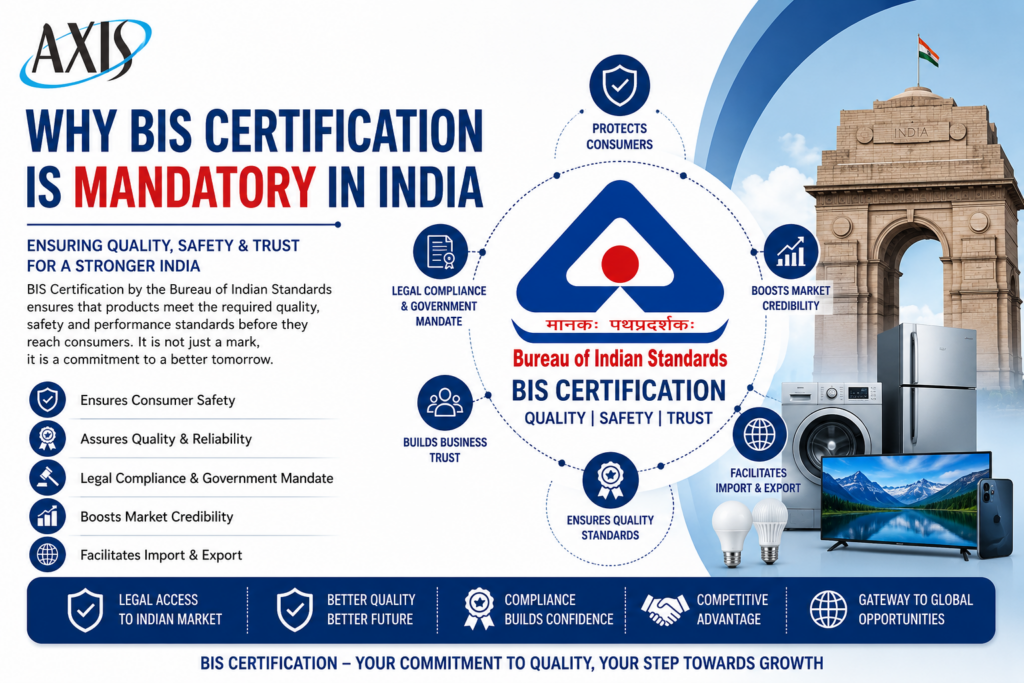
India has emerged as one of the fastest-growing consumer markets in the world, creating a strong need for product quality, safety, and regulatory control. This is precisely Why BIS Certification is Mandatory in India for a wide range of products. The certification system established by the Bureau of Indian Standards (BIS) ensures that products sold in India meet specific quality benchmarks and safety requirements.
If you are manufacturer, importer, trader, or a foreign producer, know the Why BIS Certification is Must in India for doing a successful business. BIS certification lets companies secure legal approvals and gives their customers the assurance that their products are in line with Indian standards.
What is BIS Certification India?
BIS Certification India is the compliance certification authority, a conformity assessment scheme run by the Bureau of Indian Standards to evaluate whether a product complies with relevant Indian Product Standards and safety regulations for it to enter the Indian marketplace.
Bureau of Indian Standards Certification protocol is designed to encompass various product segments such as electrical & electronics products, building materials, consumer products, chemicals and industrial products. Products under the mandatory scheme needs to be certified as it is required by law.
This regulatory framework explains Why BIS Certification is Mandatory in India for businesses operating in regulated industries.
Importance of Mandatory BIS Certification
The Indian government continuously strengthens product quality regulations to protect consumers and encourage fair trade. As a result, Mandatory BIS Certification has become an important compliance requirement for many sectors.
The key objectives include:
- Ensuring consumer safety
- Maintaining product quality consistency
- Eliminating substandard products
- Enhancing public confidence
- Supporting regulatory compliance
- Promoting fair competition
- Encouraging manufacturing excellence
These objectives clearly demonstrate Why BIS Certification is Mandatory in India for manufacturers and importers alike.
BIS Compliance Requirements for Businesses
Every business dealing with regulated products must fulfill specific BIS Compliance Requirements before launching products in India.
The certification process generally requires:
- Product testing in approved laboratories
- Technical documentation
- Quality management compliance
- Application submission
- Product evaluation
- License issuance
- Periodic compliance monitoring
Meeting these requirements helps organizations achieve BIS Regulatory Compliance and maintain uninterrupted market access.
BIS Certification for Manufacturers
Indian manufacturers must obtain BIS Certification for Manufacturers when producing products covered under mandatory standards. Certification confirms that manufacturing processes and products comply with applicable regulations.
Benefits include:
- Increased customer confidence
- Enhanced brand value
- Legal market authorization
- Better product quality control
- Reduced compliance risks
For many businesses, understanding Why BIS Certification is Mandatory in India starts with ensuring manufacturing compliance and product safety.
BIS Certification for Importers
Importers play a critical role in bringing international products to Indian consumers. Products requiring BIS Approval for Products cannot be imported legally without certification.
BIS Certification for Importers ensures that imported products meet Indian safety and performance standards. Customs authorities may reject shipments that do not comply with BIS regulations.
This import control mechanism is another reason Why BIS Certification is Mandatory in India for businesses engaged in global trade.
BIS Certification for Electronics
One of the largest certification segments involves electronics and IT equipment. Through BIS CRS Registration, manufacturers must certify various electronic products before selling them in India.
Examples include:
- Smartphones
- Laptops
- LED televisions
- Smart devices
- Wireless accessories
- Power adapters
- Electronic appliances
Growing consumer dependence on electronics further highlights Why BIS Certification is Mandatory in India to ensure electrical safety and product reliability.
BIS Certification Process
The BIS Certification Process typically includes:
Product Identification
Determining the applicable Indian standard.
Testing
Product evaluation through BIS-recognized laboratories.
Documentation
Preparation of technical files and compliance documents.
Application Filing
Submission under the relevant certification scheme.
Approval
Grant of BIS License India after successful review.
Ongoing Compliance
Regular surveillance to maintain certification validity.
Many businesses engage a BIS Registration Consultant to manage the process efficiently.
Why Choose Indiaxis for BIS Certification Support?
Indiaxis provides professional consulting services for businesses seeking BIS Certification Services India. Their experienced team supports organizations with documentation, testing coordination, application filing, and regulatory guidance.
Whether you require BIS Scheme Registration, BIS Product Certification, BIS Certification for Foreign Manufacturers, or complete compliance management, Indiaxis helps businesses achieve certification efficiently and accurately.
By partnering with experts, companies can better understand Why BIS Certification is Mandatory in India while avoiding delays and compliance challenges.
Conclusion
The growing emphasis on product safety and quality makes it clear Why BIS Certification is Mandatory in India. Certification protects consumers, supports fair competition, and ensures compliance with national standards. Businesses that obtain certification not only fulfill legal obligations but also strengthen their reputation and gain greater market acceptance.
FAQs
1. Why do I need BIS Certification in India?
In short, it guarantees that a product meets India’s safety, quality, and performance requirements before hitting the shelves.
2. So, what exactly is BIS Product Certification?
It’s a process where your product is checked and approved to ensure it adheres to the relevant BIS standards.
3. What about imported products – do they need BIS Certification?
For many controlled imported goods, yes, BIS certification is a must before they can be sold in India.
4. And what’s this BIS CRS Registration?
This is a mandatory registration process for certain electronic and IT products.
5. How can a BIS Registration Consultant help me?
A consultant is your guide! They’ll help with testing, preparing all the necessary paperwork, submitting your application, and keeping track of your compliance needs.
6. How long is a BIS License in India valid for?
The duration of your license will depend on the specific certification scheme you’re under and its renewal guidelines.
7. Can companies outside India apply for BIS Certification?
Absolutely! Foreign manufacturers are welcome to obtain BIS certification through the appropriate schemes.