
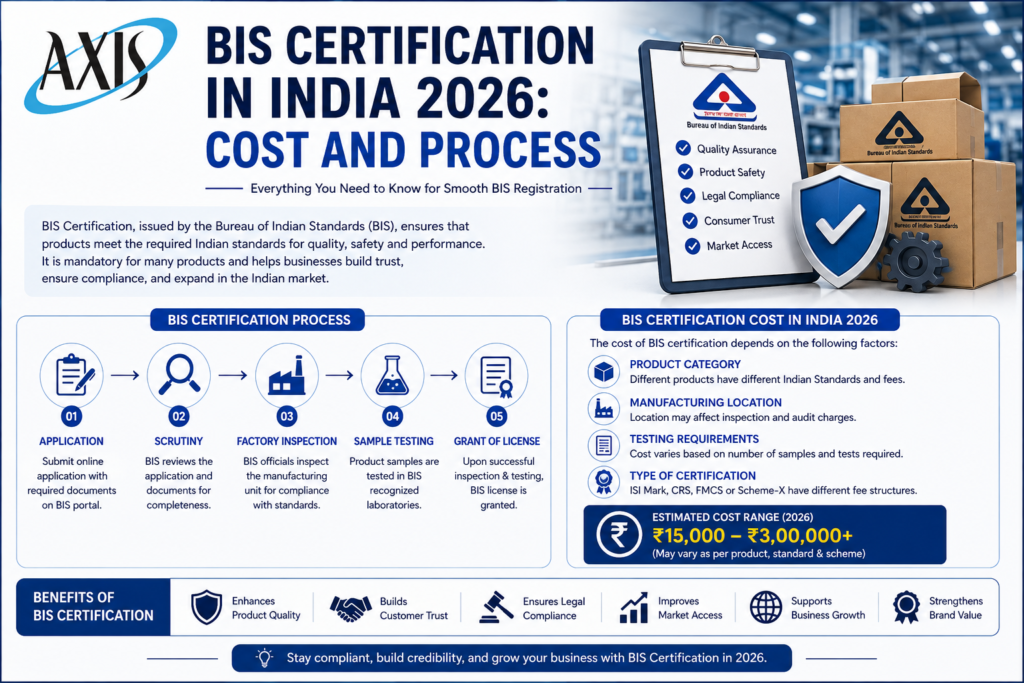
BIS certification plays an important role in ensuring that products sold in India meet prescribed standards for quality, safety, and performance. Manufacturers, importers, and foreign companies dealing with regulated products need to understand the applicable certification requirements before manufacturing, importing, distributing, or selling their products. BIS Certification in India 2026: Cost and Process is therefore an important subject for businesses planning compliant market entry.
The Bureau of Indian Standards operates different conformity assessment schemes depending on the nature of a product. Requirements may differ for industrial products, consumer goods, electronics, electrical equipment, and products manufactured outside India. Understanding the complete BIS Certification in India 2026: Cost and Process can help businesses prepare documents, testing, and applications correctly.
What Does BIS Certification Mean?
Bureau of Indian Standards Certification confirms that a product conforms to the applicable Indian Standard and regulatory requirements. Depending on the product, certification may involve product testing, factory inspection, quality-control evaluation, and licensing.
Products covered by mandatory requirements generally cannot be legally marketed in India without the applicable approval. Therefore, businesses should identify their product’s Indian Standard before beginning the application.
Who Needs BIS Certification?
BIS approval may be required by:
- Indian manufacturers
- Foreign manufacturers
- Importers
- Product brand owners
- Electronic product companies
- Electrical equipment manufacturers
- Consumer product manufacturers
The exact obligation depends on the applicable government notification and product standard.
Major BIS Certification Schemes
ISI Mark Certification
ISI Mark Certification India is commonly associated with products manufactured according to specified Indian Standards. The process can include laboratory testing and factory inspection.
BIS CRS Registration
BIS CRS Registration India primarily covers specified electronic and information technology products. Applicants generally need to submit product test reports from a recognized laboratory along with required company and product documentation.
Foreign Manufacturers Certification Scheme
Foreign companies manufacturing regulated products for the Indian market may need approval under FMCS. This provides a route for eligible overseas manufacturers to obtain a BIS license.
BIS Certification Requirements India
Before applying, businesses should verify:
- Applicable Indian Standard
- Product scope
- Testing requirements
- Manufacturing facility details
- Quality-control arrangements
- Applicable certification scheme
- Required technical documents
Early verification of BIS Certification Requirements India can prevent unnecessary testing and application delays.
BIS Certification Documents Required
The documentation can vary by scheme and product. Common documents include:
- Certificate of incorporation or business registration
- Factory address information
- Product technical specifications
- Manufacturing process information
- Test reports
- Quality-control documents
- Trademark or brand authorization documents
- Identity and authorization documents
- Details of manufacturing equipment
Complete and consistent BIS Certification Documents Required are important for smooth application processing.
BIS Certification Cost India
One of the first questions businesses ask is the expected BIS Certification in India 2026: Cost and Process. There is no single fixed amount applicable to every product.
The total cost may include:
- BIS application fees
- Laboratory testing charges
- Factory inspection expenses
- License fees
- Annual renewal charges
- Marking-related fees
- Professional consultancy charges
Consequently, the final BIS License Cost 2026 depends on the product, number of models, applicable standard, testing requirements, and certification scheme.
BIS Registration Cost and Timeline
The BIS Registration Cost and Timeline should be evaluated before starting the application. Simple registrations can generally move faster when testing and documents are already available. Certifications involving factory inspections and additional technical evaluation may take considerably longer.
Businesses should avoid relying on a fixed timeline because processing time can change according to product complexity, testing capacity, queries raised by BIS, and applicant responsiveness.
BIS Registration Process 2026
The BIS Registration Process 2026 generally involves the following stages:
1. Identify the Applicable Standard: Determine which Indian Standard applies to the product.
2. Review Certification Requirements: Establish whether ISI certification, CRS registration, FMCS, or another BIS route applies.
3. Conduct Product Testing: Arrange testing through the appropriate recognized laboratory.
4. Prepare Documentation: Compile technical and business documents.
5. Submit the Application: File the application through the relevant BIS system.
6. Respond to Queries: Provide clarifications or additional documents when requested.
7. Inspection, Where Applicable: BIS may assess the manufacturing facility for relevant certification schemes.
8. Receive Approval: After successful evaluation, the applicable BIS registration or license can be issued.
This structured BIS Approval Process India allows businesses to manage compliance requirements systematically.
BIS Compliance India 2026 for Businesses
Maintaining compliance does not end after receiving approval. Businesses should continue monitoring product quality, certification validity, testing requirements, labeling obligations, and changes to applicable standards.
Failure to maintain requirements can create regulatory and commercial risks. Regular compliance reviews are therefore important for companies holding a BIS License for Products India.
Why Professional Assistance Can Help
The BIS application process can involve technical standards, laboratory testing, documentation, and regulatory communication. A BIS Certification Consultant India can assist businesses with identifying applicable standards, preparing documentation, coordinating testing, filing applications, and responding to regulatory requirements.
Companies searching for BIS Certification Services India may also benefit from professional guidance when dealing with multiple products or complex certification requirements.
Why Choose Indiaxis?
Indiaxis can be referenced by businesses looking for professional support related to regulatory registrations and product compliance. Working with an experienced compliance service provider can help applicants understand their obligations, organize documentation, and navigate the certification workflow more efficiently.
For businesses operating in Delhi and surrounding areas, a BIS Consultant Delhi can also provide localized assistance with application preparation and compliance coordination.
Conclusion
Understanding BIS Certification in India 2026: Cost and Process is essential for businesses that manufacture, import, or sell products covered by Indian conformity requirements. The applicable cost, documentation, testing, and timeline depend on the product and certification scheme.
Proper preparation helps reduce avoidable delays and supports continued Product Certification India compliance. Businesses should identify the applicable standard, complete required testing, prepare accurate documentation, and follow the appropriate BIS application procedure.
Frequently Asked Questions
1. What is BIS Certification in India 2026?
It is a conformity assessment approval that confirms eligible products meet applicable Indian Standards and BIS requirements.
2. How is BIS Certification Cost India calculated?
The cost depends on the product, applicable standard, testing requirements, certification scheme, inspection, and applicable BIS fees.
3. What is the BIS Registration Process 2026?
It generally includes identifying the applicable standard, testing the product, preparing documents, filing the application, responding to queries, and obtaining approval.
4. Is BIS certification mandatory for every product?
No. Mandatory BIS requirements apply to products specifically covered by applicable regulations or government notifications.
5. What are the BIS Certification Documents Required?
Common documents include business details, factory information, product specifications, test reports, quality-control information, and authorization documents.
6. Can an importer apply for BIS certification?
Depending on the applicable scheme, certification may be linked to the manufacturer and product rather than simply the importer. The specific requirements should be verified before application.
7. How can a BIS Certification Consultant India help?
A consultant can assist with standard identification, documentation, laboratory coordination, application filing, regulatory communication, and compliance support.