
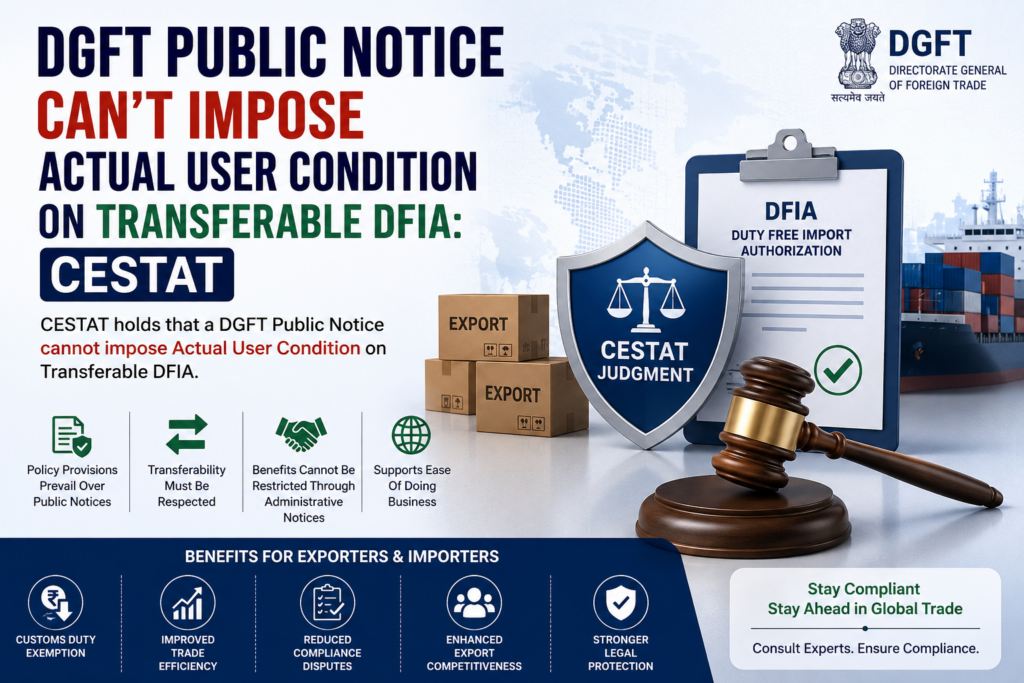
The recent DGFT Public Notice Can’t Impose Actual User Condition on Transferable DFIA: CESTAT decision has emerged as a landmark development for India’s export-import community. This ruling clarified how Duty Free Import Authorizations may be transferred and narrows the use of administrative measures to restrict trade against policies that are contrary to the established.
At Indiaxis, we assist exporters, importers, manufacturers, and traders in understanding the practical implications of the DGFT Public Notice Can’t Impose Actual User Condition on Transferable DFIA: CESTAT ruling while ensuring complete regulatory compliance.
Overview of the DFIA Scheme India
The DFIA Scheme India was introduced under the Foreign Trade Policy India to support exporters by allowing duty-free imports of inputs required for export production. The scheme reduces production costs and enhances the competitiveness of Indian products in international markets.
One of the key features of DFIA is its transferability after the completion of export obligations. The DGFT Public Notice Can’t Impose Actual User Condition on Transferable DFIA: CESTAT ruling confirms that once transferability is granted, additional restrictions cannot dilute that benefit.
This judgment has become an important reference point for businesses relying on Duty Free Import Authorization benefits.
Understanding Transferable DFIA
A Transferable DFIA allows the authorization holder to transfer the license to another eligible entity after fulfilling prescribed conditions. Such transferability creates flexibility in the market and allows businesses to monetize unused authorizations.
The DGFT Public Notice Can’t Impose Actual User Condition on Transferable DFIA: CESTAT ruling emphasized that transferable authorizations should retain their unrestricted character. If an Actual User Condition is imposed after transferability is granted, it defeats the purpose of the scheme.
Therefore, the tribunal clarified that policy benefits should remain consistent with the provisions of the Foreign Trade Policy.
What Was the Core Issue?
The dispute revolved around whether a DGFT Public Notice could introduce an Actual User Condition on a DFIA that had already become transferable under applicable policy provisions.
Authorities attempted to rely on administrative notifications to restrict the use of transferable DFIAs. However, the tribunal observed that public notices cannot override policy provisions or statutory benefits.
As a result, the DGFT Public Notice Can’t Impose Actual User Condition on Transferable DFIA: CESTAT judgment reaffirmed the legal rights of authorization holders.
Key Findings of the CESTAT Judgment
The significant CESTAT Judgment highlighted several important principles:
Policy Provisions Prevail
Trade benefits provided under the policy framework cannot be restricted through procedural notices.
Transferability Must Be Honored
Once a DFIA becomes transferable, it should remain transferable without additional user-based restrictions.
Legal Certainty Is Essential
Businesses require predictable regulations to make informed commercial decisions.
Administrative Powers Have Limits
Public notices cannot contradict the intent of the Foreign Trade Policy.
The CESTAT Ruling on DFIA therefore strengthens confidence among exporters and importers operating under government incentive schemes.
Benefits of the Judgment
The DGFT Public Notice Can’t Impose Actual User Condition on Transferable DFIA: CESTAT ruling offers several advantages:
Better Business Flexibility
Companies can transfer eligible DFIA licenses without uncertainty.
Improved Regulatory Clarity
The ruling simplifies interpretation of DFIA Transferability Rules.
Reduced Compliance Disputes
Importers face fewer legal challenges regarding license usage.
Stronger Export Promotion
The decision supports DFIA Benefits for Exporters and enhances competitiveness.
Protection of Trade Rights
Businesses can enjoy incentives as originally intended under the policy framework.
Importance of Customs and Trade Compliance
Even with favorable rulings, organizations must maintain robust Customs Compliance India systems. Proper documentation, import records, and regulatory monitoring remain essential for availing benefits under various export promotion schemes.
Companies should also track DGFT Notification Updates, regulatory amendments, and customs circulars to avoid compliance risks.
The DGFT Public Notice Can’t Impose Actual User Condition on Transferable DFIA: CESTAT ruling reinforces the need for proper legal interpretation while maintaining full compliance.
How Indiaxis Supports Businesses
At Indiaxis, we provide specialized support for:
- DFIA application and management
- DGFT authorization services
- Import Export License India assistance
- Export incentive advisory
- Customs compliance solutions
- Regulatory representation
- Trade policy consultation
- DGFT Consultant Services
Our experts help organizations understand the impact of the DGFT Public Notice Can’t Impose Actual User Condition on Transferable DFIA: CESTAT judgment and leverage available benefits effectively.
Why Choose Indiaxis?
Businesses choose Indiaxis because of:
- Extensive DGFT expertise
- Customized compliance solutions
- Professional documentation support
- Fast processing assistance
- Strong regulatory knowledge
- End-to-end trade advisory
With increasing focus on international trade, understanding decisions like DGFT Public Notice Can’t Impose Actual User Condition on Transferable DFIA: CESTAT is critical for maintaining compliance and maximizing business opportunities.
Frequently Asked Questions (FAQs)
1. What is DFIA?
DFIA is a Duty Free Import Authorization scheme that allows duty-free import of inputs used for export production.
2. What is a Transferable DFIA?
A Transferable DFIA can be sold or transferred to another eligible party after export obligations are fulfilled.
3. What is the Actual User Condition in DFIA?
It is a restriction requiring imported goods to be used only by the original authorization holder.
4. What did CESTAT decide?
The tribunal ruled that a public notice cannot impose an Actual User Condition on a transferable DFIA.
5. How does the judgment benefit exporters?
It protects transferability rights and preserves benefits available under the Foreign Trade Policy.
6. Why is trade policy compliance important?
Proper compliance helps businesses avoid penalties and maximize export incentives.
7. Does the ruling affect customs duty exemption benefits?
Yes, it supports the lawful use of customs duty exemption benefits available under DFIA.
8. How can Indiaxis help?
Indiaxis provides DFIA advisory, DGFT compliance support, customs guidance, and export-import consulting services.