
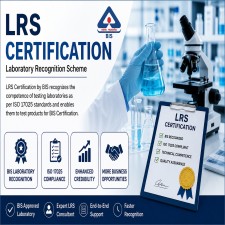
LRS Certification is a formal approval granted to testing laboratories under the Laboratory Recognition Scheme (LRS) by the Bureau of Indian Standards. It authorizes laboratories to conduct product testing as per Indian Standards for certification purposes.
Under the BIS Recognition Scheme, laboratories must demonstrate technical competence, quality systems, and reliable testing capabilities. Achieving LRS approval ensures that your laboratory is recognized as a BIS-approved laboratory, capable of supporting manufacturers in regulatory compliance.
At Indiaxis, we provide comprehensive LRS Services India to help laboratories navigate the certification process seamlessly.
Key Features of Laboratory Recognition Scheme (LRS)
The Laboratory Recognition Scheme (LRS) is designed to maintain uniformity and quality in testing across India.
Major Highlights:
- Recognition by BIS for authorized testing
- Alignment with ISO 17025 Laboratory standards
- Evaluation of technical competence
- Mandatory for testing under BIS certification
With LRS Certification, laboratories become an integral part of India’s quality assurance ecosystem.
Benefits of LRS Certification for Laboratories
Obtaining LRS certificate provides long-term advantages:
1. Enhanced Credibility
Recognition as a BIS-approved laboratory builds trust among clients and regulatory bodies.
2. Regulatory Compliance
Ensures adherence to the BIS Recognition Scheme and Indian standards.
3. Increased Business Scope
Labs can partner with manufacturers needing BIS certification.
4. Quality Assurance
Compliance with ISO 17025 Laboratory improves testing accuracy.
5. Competitive Edge
Certified labs gain preference over non-recognized labs.
Who Should Apply for LRS Certification?
LRS Certification is ideal for:
- Independent testing laboratories
- In-house R&D labs of manufacturers
- Government testing facilities
- Academic and research laboratories
Any lab involved in product testing for regulatory approvals should obtain BIS Laboratory Recognition.
Complete LRS Certification Process
The process for obtaining LRS Certification is structured and detailed:
1. Gap Analysis
A professional LRS Consultant evaluates your lab’s readiness.
2. Documentation Preparation
Preparation of quality manuals, SOPs, and compliance records.
3. Application Submission
Filing an application under the Laboratory Recognition Scheme (LRS).
4. BIS Audit
On-site inspection by BIS officials to verify compliance.
5. Grant of Certification
Successful labs receive BIS Laboratory Recognition.
With Indiaxis, the entire process is streamlined and efficient.
Importance of ISO 17025 in LRS Certification
Compliance with ISO 17025 Laboratory standards is a core requirement for LRS Certification.
This standard ensures:
- Accuracy in testing methods
- Calibration of equipment
- Competence of technical staff
- Proper documentation and reporting
Without ISO compliance, obtaining LRS Certification becomes challenging.
Role of NABL Accreditation
The National Accreditation Board for Testing and Calibration Laboratories provides accreditation that strengthens your laboratory’s credibility.
While NABL Laboratory Recognition is separate, it complements LRS approval by:
- Increasing trust and acceptance
- Improving approval chances
- Demonstrating technical expertise
Many labs pursue both certifications for better market positioning.
Documents Required for LRS Approval
Essential documents include:
- ISO 17025 Quality Manual
- Calibration certificates of equipment
- Staff qualification records
- Internal audit reports
- Test method validation data
- Scope of testing
Our Laboratory Recognition Consultant ensures accurate and complete documentation.
Why Choose Indiaxis for LRS Certification?
Indiaxis is a leading provider of LRS Services India, offering expert consulting and end-to-end support.
Our Expertise Includes:
- Dedicated LRS Consultant support
- Complete documentation assistance
- Pre-audit and compliance checks
- BIS coordination and follow-ups
- Quick and hassle-free approvals
We help laboratories achieve LRS Certificate with minimal delays and maximum efficiency.
Industries Covered Under LRS Certification
LRS Certification is applicable across various sectors:
- Electronics and electrical testing
- Chemical and material testing
- Construction and infrastructure
- Automotive and mobility
- Consumer product testing
Being a BIS Approved Laboratory allows you to serve multiple industries.
Common Mistakes to Avoid
While applying for LRS Certificate, laboratories often make mistakes such as:
- Incomplete documentation
- Lack of ISO 17025 compliance
- Improper calibration of equipment
- Untrained staff
Working with an experienced LRS Consultant helps avoid these issues.
Conclusion
LRS Certification is essential for laboratories aiming to gain recognition under the Laboratory Recognition Scheme (LRS). It ensures compliance, enhances credibility, and enables laboratories to contribute to India’s quality infrastructure.
With expert support from Indiaxis, obtaining BIS Laboratory Recognition becomes a smooth and efficient process. From documentation to final approval, we ensure your lab meets all compliance standards.
FAQs
1. What is LRS Certification?
It is BIS recognition granted to laboratories under the Laboratory Recognition Scheme for testing compliance.
2. Who issues LRS Certification?
The Bureau of Indian Standards (BIS) issues LRS Certification.
3. Is ISO 17025 mandatory?
Yes, compliance with ISO 17025 Laboratory standards is required.
4. What is NABL’s role in LRS Approval?
NABL Laboratory Recognition enhances credibility but is separate from BIS recognition.
5. How long does it take to get LRS Certification?
The process typically takes 30 to 90 days.
6. Can startups apply for LRS Certification?
Yes, if they meet all technical and compliance requirements.
7. Why hire an LRS Consultant?
An LRS Consultant ensures smooth processing, accurate documentation, and faster approvals.