
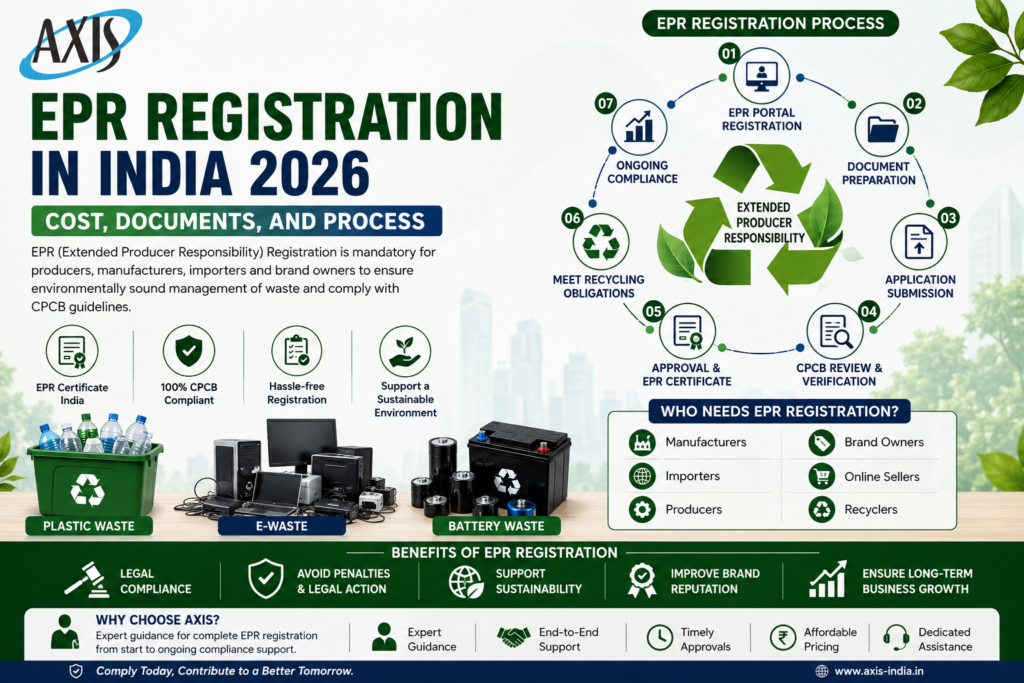
Businesses operating in India must understand EPR Registration in India 2026: Cost, Documents, and Process to comply with environmental regulations and avoid legal complications. The Extended Producer Responsibility framework places accountability on producers, importers, and brand owners for the collection, recycling, and disposal of post-consumer waste generated by their products.
As environmental compliance becomes stricter in 2026, obtaining EPR authorization is no longer optional for covered businesses. Companies dealing with electronic products, batteries, packaging materials, and plastic waste must register through the Central Pollution Control Board (CPCB) portal and fulfill prescribed recycling targets.
Indiaxis helps organizations navigate the complete registration process with expert consultation, documentation support, and compliance management services.
Understanding Extended Producer Responsibility (EPR)
Extended Producer Responsibility Registration is an environmental compliance mechanism introduced to reduce waste and improve recycling infrastructure across India. Under EPR regulations, businesses are required to take responsibility for managing waste generated from products they introduce into the market.
The system applies to multiple sectors, including:
- Electronics and electrical equipment
- Plastic packaging materials
- Batteries and accumulators
- Consumer goods manufacturers
- Importers and traders
- Brand owners
EPR Compliance 2026 aims to encourage sustainable business practices while minimizing environmental impact.
Why EPR Registration Matters in 2026
The Indian government has increased focus on waste management and circular economy initiatives. As a result, businesses without proper EPR Authorization India may face regulatory action, penalties, or restrictions on market operations.
Major reasons for obtaining registration include:
Regulatory Compliance
Meet CPCB requirements and industry regulations.
Business Continuity
Continue manufacturing, importing, and selling products legally.
Corporate Sustainability
Demonstrate environmental responsibility to customers and stakeholders.
Improved Market Reputation
Enhance brand trust through compliance and sustainability initiatives.
Risk Management
Reduce the likelihood of penalties and legal disputes.
Categories Covered Under EPR
Different EPR frameworks exist for various waste streams.
E-Waste EPR Registration
Applicable to manufacturers, importers, and brand owners of electronic and electrical products.
Plastic Waste EPR Registration
Required for businesses introducing plastic packaging into the Indian market.
Battery Waste EPR Registration
Mandatory for companies involved in manufacturing, importing, or selling batteries.
Each category has unique compliance obligations and recycling targets.
Essential Documents Required
Before initiating the EPR Application Process, businesses must gather supporting documentation.
Common EPR Registration Documents Required include:
- PAN Card of the company
- GST Registration Certificate
- Certificate of Incorporation
- IEC Certificate for importers
- Authorized Signatory Details
- Product Information
- Brand Ownership Details
- Sales Records
- Import Records
- Waste Management Plan
- Recycling Agreements
- Company Address Proof
Accurate documentation significantly improves approval timelines and reduces the possibility of application rejection.
Complete EPR Registration Process India
The registration procedure follows a structured approach.
Initial Compliance Assessment
The business category and product type are evaluated to determine EPR obligations.
Document Collection
All required records and supporting documents are organized and verified.
Portal Account Creation
The applicant completes EPR Portal Registration on the CPCB platform.
Application Submission
Relevant information and supporting documentation are uploaded.
Review by Authorities
CPCB officials examine the application and verify compliance details.
Clarification Stage
Additional information may be requested if required.
Certificate Approval
Upon successful review, the applicant receives the EPR Certificate India.
Businesses seeking EPR Registration in India 2026: Cost, Documents, and Process should ensure that applications are complete and accurate to avoid unnecessary delays.
EPR Registration Cost 2026
The EPR Registration Cost 2026 varies depending on several business-specific factors.
These include:
- Product category
- Annual turnover
- Volume of products sold
- Waste generation estimates
- Applicable recycling obligations
- Government fees
- Consultant services
Therefore, EPR Registration Fees India differ from one business to another. A detailed compliance assessment is generally required before estimating the exact cost.
Advantages of Professional EPR Consultancy
Many organizations choose experienced consultants to streamline the process.
Benefits include:
- Faster documentation preparation
- Accurate application filing
- CPCB compliance guidance
- Reduced risk of rejection
- Ongoing reporting support
- Annual compliance assistance
- Regulatory updates and advisory services
An experienced EPR Registration Consultant India can help businesses meet all obligations efficiently.
Why Choose Indiaxis?
Indiaxis offers comprehensive support for:
- Extended Producer Responsibility Registration
- CPCB EPR Registration
- EPR Portal Registration
- Documentation preparation
- Compliance audits
- Regulatory consultation
- Post-approval compliance support
The objective is to simplify the registration journey while ensuring complete adherence to EPR Rules 2026.
Final Thoughts
Businesses operating in regulated sectors should prioritize EPR Registration in India 2026: Cost, Documents, and Process to maintain compliance and support environmental sustainability. Proper registration, documentation, and recycling commitments are essential for avoiding penalties and ensuring uninterrupted operations. Whether your organization requires Plastic Waste EPR Registration, E-Waste EPR Registration, or Battery Waste EPR Registration, obtaining expert guidance can significantly improve efficiency and compliance outcomes.
FAQs
1. What is the purpose of EPR registration?
It requires producers and importers to be responsible for disposing of the waste created by their goods.
2. Is CPCB approval mandatory for EPR compliance?
Registration of such applicable business with CPCB is compulsory.
3. Which businesses require EPR registration?
Requires registration for manufacturers, importers, producers, brand owners, some recyclers.
4. Can importers apply for EPR registration?
EPR authorization is required for importers of covered products.
5. How long is an EPR certificate valid?
Validity is determined by the pertinent CPCB guidelines and registration category.
6. What affects EPR registration fees?
Variance in charges according to category of product, turnover, nature of waste and compliance requirements.
7. Why hire an EPR compliance consultant?
Consultants will assist you in processing documentation, filing, obtaining necessary approvals, and keeping up with your compliance requirements.