
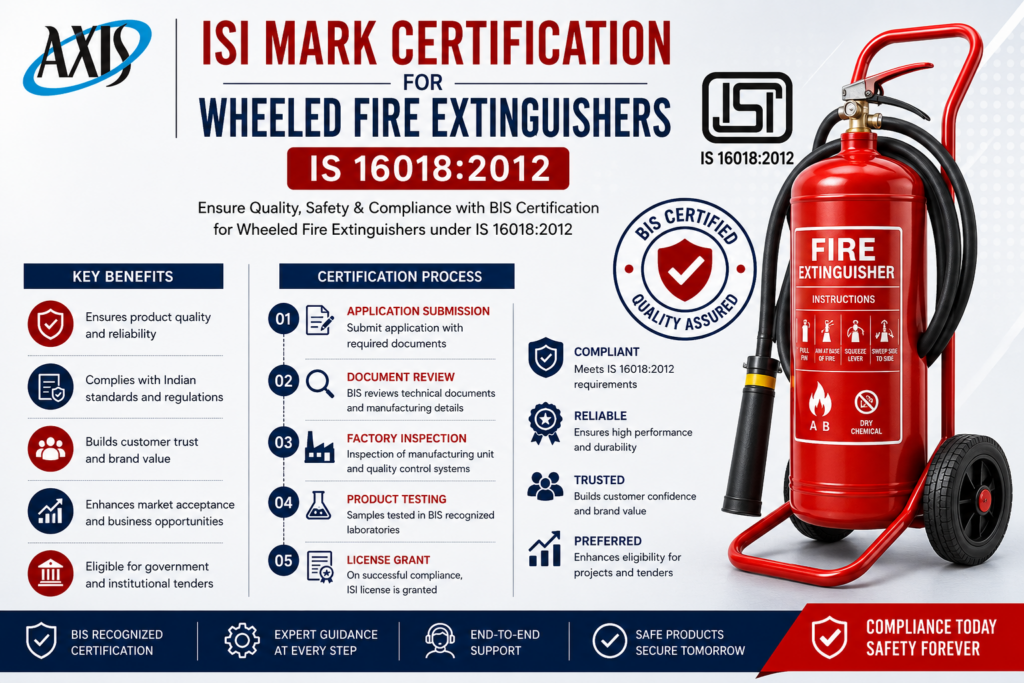
ISI Mark Certification for Wheeled Fire Extinguishers IS 16018:2012 is an important quality assurance requirement for manufacturers producing large-capacity fire extinguishing equipment in India. These extinguishers are commonly deployed in industries, refineries, warehouses, airports, and commercial facilities where immediate fire suppression is critical. Compliance with the applicable Indian Standard helps manufacturers demonstrate product reliability, safety, and conformity with national regulations.
BIS (Bureau of Indian Standards) is the certifying body to allow the manufacturing and selling of fire protection equipment to Indian customers. By taking BIS certification and compliance measures the company gets market confidence and a boost in customers confidence.
Understanding the Need for Certification
Emergency services will never purchase equipment that is not guaranteed to function at the time of a crisis. In an emergency, failing to do its job can mean considerable property loss and possibly loss of life, hence the strict adherence of manufacturers to precise technical requirements and tests before the product is approved for public sale.
Manufacturing ofwheeled fire extinguishers certified by ISI are manufactured as per stipulated quality standards. These certifications also vouchsafe compliance to the laid-down manufacturing practices, testing norms and performance of the fire extinguisher
Key objectives include:
- Maintaining consistent product quality
- Ensuring operational reliability
- Promoting public safety
- Supporting regulatory compliance
- Strengthening customer trust
What Is Covered Under IS 16018:2012?
The standard establishes technical requirements for wheeled fire extinguishers used in industrial and commercial applications. It defines criteria related to product design, construction, safety features, performance testing, and quality control.
Important areas addressed include:
- Product construction requirements
- Capacity specifications
- Extinguishing performance
- Material quality standards
- Pressure resistance parameters
- Inspection procedures
- Product marking requirements
Manufacturers seeking IS 16018:2012 Compliance must ensure that every aspect of production aligns with these requirements.
Steps Involved in BIS Certification
The BIS License for Fire Extinguishers is granted only after successful completion of a structured evaluation process.
Application Filing
The manufacturer submits an application along with product details, factory information, and compliance-related documents.
Technical Review
BIS officials examine technical specifications, quality management procedures, and manufacturing capabilities.
Factory Assessment
A detailed inspection is conducted to verify production facilities, testing equipment, and quality assurance systems.
Product Evaluation
Samples are collected and tested in approved laboratories to confirm compliance with prescribed standards.
License Grant
After satisfactory review of all requirements, BIS issues the certification license authorizing the use of the ISI mark.
This procedure forms the foundation of BIS Scheme-I Certification for fire safety products.
Laboratory Testing Requirements
Testing is a critical component of Fire Extinguisher Testing and Certification India. Products must successfully pass various assessments designed to verify operational performance and durability.
Typical evaluations include:
- Discharge performance tests
- Leakage assessments
- Pressure endurance tests
- Functional performance verification
- Structural integrity checks
- Safety mechanism evaluations
Successful testing is essential for obtaining Wheeled Fire Extinguisher Approval.
Essential Documents Required
Manufacturers generally need to provide:
- Business registration certificates
- Factory registration documents
- Manufacturing process details
- Product drawings and specifications
- Testing facility information
- Quality control procedures
- Machinery lists
- Authorized representative details
Accurate documentation significantly improves approval efficiency and reduces compliance delays.
Challenges Faced by Manufacturers
Many businesses encounter difficulties during certification due to:
- Incomplete documentation
- Incorrect technical submissions
- Delays in laboratory testing
- Non-compliance findings during inspections
- Lack of understanding of BIS requirements
To overcome these challenges, many manufacturers seek assistance from compliance specialists familiar with Product Certification for Fire Safety Equipment and regulatory procedures.
Organizations such as Indiaxis assist businesses in navigating certification requirements, coordinating testing activities, preparing documentation, and ensuring smooth communication with certification authorities.
Advantages of Certification
Obtaining certification offers numerous commercial and regulatory benefits.
Improved Market Recognition
Certified products gain greater acceptance among buyers and procurement agencies.
Enhanced Safety Assurance
Compliance demonstrates adherence to recognized Fire Extinguisher Quality Standards India.
Competitive Business Advantage
Certification differentiates products from non-certified alternatives.
Regulatory Confidence
Authorities and institutional purchasers often prefer certified fire safety products.
Better Customer Trust
The ISI mark serves as a visible symbol of quality and reliability.
Conclusion
ISI Mark Certification for Wheeled Fire Extinguishers IS 16018:2012 offers a recognized framework to help manufacturers guarantee product safety, quality, and compliance. Manufacturers can obtain certification for their products by satisfying all the required technical specifications, conducting laboratory tests and submitting them according toBIS standards and guidelines. Pursuing BIS Certification for Fire Extinguishers, Fire Extinguisher Manufacturing Certification, or ISI Registration for Wheeled Fire Extinguishers will prove to be a wise business investment for the company and the overall quality of the product.
FAQs
1. Who needs ISI certification for wheeled fire extinguishers?
Manufacturers producing wheeled fire extinguishers intended for sale in India may require certification to demonstrate compliance with applicable standards.
2. What is the role of BIS in certification?
BIS evaluates products, manufacturing facilities, testing procedures, and compliance with Indian Standards before granting certification.
3. What is Wheeled Fire Extinguisher Approval?
It refers to the successful compliance verification and certification of wheeled fire extinguishers under applicable standards.
4. Are factory inspections mandatory?
Yes, factory inspections are generally conducted to assess manufacturing and quality control systems.
5. How important is laboratory testing?
Testing is essential because it verifies safety, durability, and extinguishing performance before certification approval.
6. What are the benefits of BIS Scheme-I Certification?
It improves product credibility, market acceptance, regulatory compliance, and customer confidence.
7. Can certification help in government tenders?
Yes, certified products are often preferred in government, institutional, and large-scale procurement projects.