
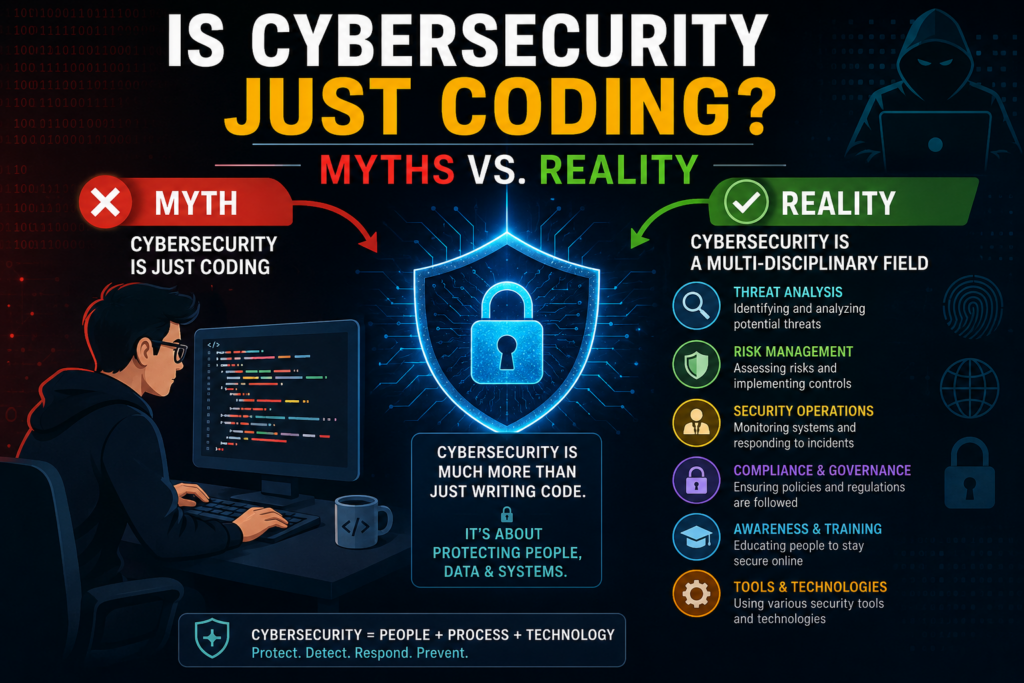
The cybersecurity industry is expanding rapidly as businesses, governments, and individuals face increasing digital threats. However, one common misconception continues to discourage many aspiring professionals from entering the field: the belief that cybersecurity is only about programming. The question “Is cybersecurity just coding? Myths vs. Reality“ deserves a closer examination because the answer may surprise many people considering a future in technology.
At Indiaxis, we often encounter students and working professionals who assume that cybersecurity careers are limited to expert coders. While programming knowledge can be useful, cybersecurity encompasses far more than writing code. It is a multidisciplinary field that combines technology, strategy, risk management, and security operations.
Understanding Is cybersecurity just coding? Myths vs. Reality can help individuals identify the right career path and appreciate the broad opportunities available in the cybersecurity ecosystem.
The Biggest Cybersecurity Myth
One of the most widespread Cybersecurity Myths and Facts discussions revolves around coding. Many people believe that if they cannot write software, they cannot succeed in cybersecurity.
In reality, cybersecurity professionals perform numerous tasks that require analytical thinking, communication, and security expertise rather than programming. Security teams investigate incidents, monitor networks, assess risks, develop policies, and educate employees on safe digital practices.
This is a key reason why Is cybersecurity just coding? Myths vs. Reality remains an important topic for beginners and professionals alike.
Cybersecurity vs Coding: Understanding the Difference
The comparison of Cybersecurity vs Coding often leads to confusion because the two fields overlap in certain areas.
Coding focuses on developing applications, websites, and software systems. Cybersecurity focuses on protecting those systems from attacks, vulnerabilities, and unauthorized access.
A programmer builds software. A cybersecurity expert secures software, networks, databases, and infrastructure.
When discussing Is cybersecurity just coding? Myths vs. Reality, it becomes clear that coding represents only one part of a much broader security framework.
Essential Cybersecurity Skills Required
Successful cybersecurity professionals rely on a diverse skill set.
Important Cybersecurity Skills Required include:
- Critical thinking
- Security monitoring
- Threat analysis
- Risk assessment
- Incident response
- Communication skills
- Compliance knowledge
- Network management
- Security auditing
- Data Protection and Security expertise
Many of these skills do not require extensive programming knowledge, reinforcing the reality behind Is cybersecurity just coding? Myths vs. Reality.
Cybersecurity Without Coding Careers
The concept of Cybersecurity Without Coding is becoming increasingly popular as organizations recognize the need for specialists in non-technical security functions.
Examples include:
- Security Analyst Career roles
- Cybersecurity Awareness coordinators
- Governance and compliance professionals
- Risk management consultants
- Security auditors
- Information security managers
These positions demonstrate that cybersecurity welcomes individuals with varied educational and professional backgrounds.
This reality directly addresses the question: Is cybersecurity just coding? Myths vs. Reality.
Importance of Information Security Solutions
Modern businesses depend heavily on Information Security Solutions to safeguard valuable assets and maintain customer trust.
Organizations implement:
- Data Protection and Security controls
- Access management systems
- Security monitoring platforms
- Vulnerability assessments
- Incident response strategies
- Cyber Threat Prevention programs
Professionals responsible for managing these solutions often focus on operational security rather than software development.
Therefore, Is cybersecurity just coding? Myths vs. Reality becomes easier to answer when examining real-world cybersecurity responsibilities.
Ethical Hacking Services and Security Testing
Some cybersecurity roles involve technical testing and vulnerability assessment through Ethical Hacking Services.
Ethical hackers identify weaknesses before cybercriminals can exploit them. While some scripting and technical knowledge may be beneficial, ethical hacking also requires:
- Research skills
- Security methodology knowledge
- Network analysis
- Vulnerability assessment expertise
- Reporting capabilities
This illustrates how cybersecurity combines multiple disciplines rather than relying solely on coding.
Cybersecurity Career Opportunities Continue to Grow
A strong Cybersecurity Career Guide highlights numerous employment opportunities across industries.
Popular Cybersecurity Career Opportunities include:
- Security Operations Center Analyst
- Security Analyst Career professional
- Incident Response Specialist
- Risk Management Consultant
- Network Security Management expert
- Compliance Manager
- Threat Intelligence Analyst
- Security Consultant
The diversity of these roles further demonstrates the truth behind Is cybersecurity just coding? Myths vs. Reality.
Modern Cybersecurity Practices in Organizations
Today’s organizations follow advanced Modern Cybersecurity Practices to reduce security risks.
These include:
- Continuous monitoring
- Threat intelligence programs
- Cloud security management
- Multi-factor authentication
- Employee Cybersecurity Awareness initiatives
- Security audits
- Vulnerability scanning
- Incident response planning
Many of these activities focus on strategic protection rather than software programming.
This practical perspective helps clarify Is cybersecurity just coding? Myths vs. Reality for aspiring professionals.
Cybersecurity for Beginners: Getting Started
For those interested in Cybersecurity for Beginners, the field offers numerous learning opportunities.
Professional Cybersecurity Training programs typically cover:
- Security fundamentals
- Networking concepts
- Threat management
- Security operations
- Risk assessment
- Digital Security Solutions
These foundational skills create pathways into cybersecurity without requiring advanced programming expertise.
As a result, Is cybersecurity just coding? Myths vs. Reality becomes less intimidating and more accessible for newcomers.
Conclusion
The reality behind Is cybersecurity just coding? Myths vs. Reality is that cybersecurity extends far beyond programming. While coding can be useful in certain technical specializations, most cybersecurity roles involve security analysis, governance, compliance, monitoring, and risk management.
Organizations increasingly depend on IT Security Services, Information Security Solutions, Cyber Threat Prevention, and Digital Security Solutions to protect their operations. This demand continues to create exciting and diverse Cybersecurity Career Opportunities for professionals with a wide range of skills and backgrounds.
Frequently Asked Questions (FAQs)
1. Is cybersecurity only for programmers?
No. Many cybersecurity roles focus on analysis, compliance, monitoring, and risk management rather than programming.
2. Can I learn cybersecurity without coding?
Yes. Many beginner cybersecurity paths emphasize networking, security fundamentals, and threat management.
3. What are the best entry-level cybersecurity roles?
Security analyst, compliance specialist, SOC analyst, and risk management assistant are common starting positions.
4. Is ethical hacking entirely coding-based?
No. Ethical hacking also involves research, vulnerability assessment, reporting, and security analysis.
5. What skills are important for cybersecurity careers?
Critical thinking, communication, risk assessment, incident response, and security monitoring are highly valuable.
6. Does cybersecurity have strong job demand?
Yes. Global demand for cybersecurity professionals continues to grow across industries.
7. What is the difference between cybersecurity and software development?
Software development creates applications, while cybersecurity protects systems and data from threats.
8. Can non-technical professionals enter cybersecurity?
Yes. Governance, compliance, awareness, and risk management roles often welcome non-technical candidates.
9. What does network security management involve?
It focuses on protecting network infrastructure, monitoring activity, and preventing unauthorized access.
10. Why is cybersecurity important for businesses?
Cybersecurity protects sensitive information, prevents cyberattacks, supports compliance, and strengthens customer trust.