
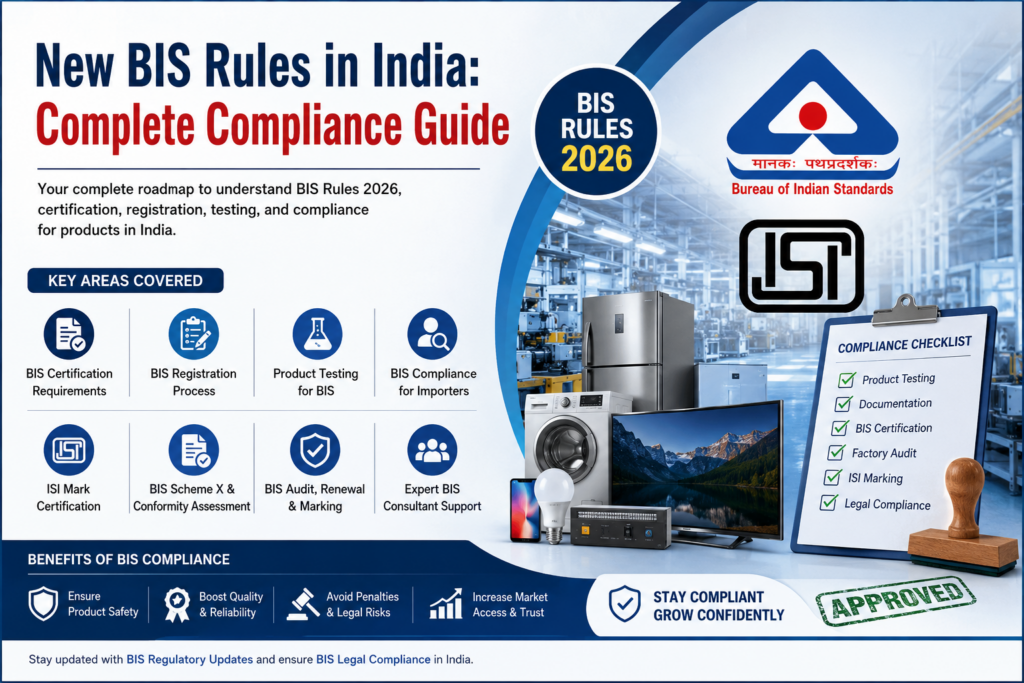
The regulatory landscape for product quality and safety in India continues to evolve, making it essential for manufacturers and importers to stay informed. This New BIS Rules in India: Complete Compliance Guide provides a detailed overview of the latest requirements introduced under BIS Rules 2026 and explains how businesses can achieve full compliance with national standards.
Bureau of Indian Standards Compliance framework: Safeguarding consumer safety, product quality and product confidence – both for local and foreign products. Companies aware of these standards and following them will not incur fines, achieve efficiency, and open new markets for their products.
Why the New BIS Rules Matter
The New BIS Rules in India: Complete Compliance Guide highlights significant regulatory changes affecting various industries, including electronics, industrial products, household appliances, construction materials, and consumer goods.
Indian Quality Standards continue to grow with the government’s plan of widening the scope of goods that fall under mandatory certification processes. Given these standards, more number of businesses would be obliged to secure Mandatory BIS Certification for their products before they can be offered to consumers in the country.
Compliance is no longer simply a regulatory requirement; it has become a key business necessity for maintaining competitiveness and consumer trust.
Overview of BIS Certification India
BIS Certification India serves as proof that a product meets the safety, quality, and performance standards established by the Bureau of Indian Standards.
Benefits of certification include:
- Improved brand reputation
- Enhanced customer confidence
- Easier market entry
- Reduced compliance risks
- Better regulatory acceptance
The New BIS Rules in India: Complete Compliance Guide emphasizes the importance of certification for both domestic manufacturers and foreign suppliers entering the Indian market.
Understanding the BIS Registration Process
A successful BIS Registration Process requires careful planning and compliance with all technical requirements.
The process generally includes:
- Product classification
- Identification of applicable standards
- Product Testing for BIS
- Preparation of compliance documents
- BIS License Application
- Assessment and approval
- License issuance
Businesses that follow the New BIS Rules in India: Complete Compliance Guide can streamline certification and reduce approval delays.
BIS Certification Requirements for Manufacturers
Manufacturers must meet specific BIS Certification Requirements to qualify for certification.
Common requirements include:
- Manufacturing facility information
- Product technical specifications
- Quality management records
- Test reports from approved laboratories
- Compliance declarations
Accurate BIS Compliance Documentation is one of the most important factors influencing approval success.
BIS Compliance for Importers
The updated regulatory framework places greater responsibility on importers. BIS Compliance for Importers requires products to meet all applicable standards before being introduced into the Indian market.
The New BIS Rules in India: Complete Compliance Guide explains that importers must ensure proper certification, testing, labeling, and documentation for covered products.
Failure to comply may result in customs clearance issues, penalties, or product restrictions.
BIS Certification for Electronics
Electronics remain one of the most regulated sectors under the BIS framework. BIS Certification for Electronics applies to various products covered under the BIS CRS Registration scheme.
Examples include:
- Mobile devices
- Power banks
- Adapters
- LED products
- IT equipment
- Smart appliances
The BIS Standards Update 2026 introduces stricter monitoring and testing requirements for many electronic products.
BIS Scheme X and Product Certification
The implementation of BIS Scheme X has expanded certification obligations for several industrial and infrastructure-related products.
This scheme strengthens BIS Conformity Assessment procedures and ensures that products consistently meet regulatory expectations.
Organizations must evaluate whether their products fall under the scope of newly regulated categories.
BIS Audit Requirements and Compliance Monitoring
Certification is not a one-time process. Businesses must continue meeting BIS Audit Requirements to maintain approval status.
Audits typically review:
- Manufacturing practices
- Product consistency
- Quality control systems
- Compliance records
- Marking procedures
The New BIS Rules in India: Complete Compliance Guide recommends establishing internal compliance systems to support ongoing certification maintenance.
BIS Marking Requirements and ISI Certification
Products approved under BIS schemes may require specific markings. Compliance with BIS Marking Requirements ensures proper identification and regulatory acceptance.
For many regulated products, ISI Mark Certification serves as visible proof of compliance with Indian standards.
Proper labeling plays a crucial role in avoiding enforcement actions and maintaining market credibility.
The Role of Professional Compliance Support
Keeping pace with regulatory changes can be challenging for businesses. Professional BIS Certification Consultants help organizations manage testing, documentation, audits, and certification requirements efficiently.
Companies such as Indiaxis assist manufacturers and importers in understanding BIS Regulatory Updates, managing certification projects, and achieving complete BIS Legal Compliance India requirements.
The New BIS Rules in India: Complete Compliance Guide serves as an essential resource for businesses seeking long-term regulatory compliance and sustainable growth in the Indian market.
FAQs
1. What is BIS Certification India?
It is an official certification confirming that a product complies with applicable Indian quality and safety standards.
2. Who needs Mandatory BIS Certification?
Manufacturers and importers of products listed under mandatory BIS schemes must obtain certification.
3. What is BIS CRS Registration?
The Compulsory Registration Scheme applies primarily to electronics and IT products.
4. What is BIS Scheme X?
It is a regulatory framework covering specific industrial products requiring enhanced conformity assessment.
5. What are BIS Audit Requirements?
Audits verify ongoing compliance with quality, manufacturing, and certification requirements.
6. How important is Product Testing for BIS?
Testing is mandatory because it confirms compliance with relevant standards before certification approval.
7. What is the purpose of ISI Mark Certification?
The ISI Mark indicates that a product complies with prescribed Indian quality standards.
8. Can importers apply for BIS certification?
Yes, importers and foreign manufacturers can obtain certification through applicable BIS schemes.