
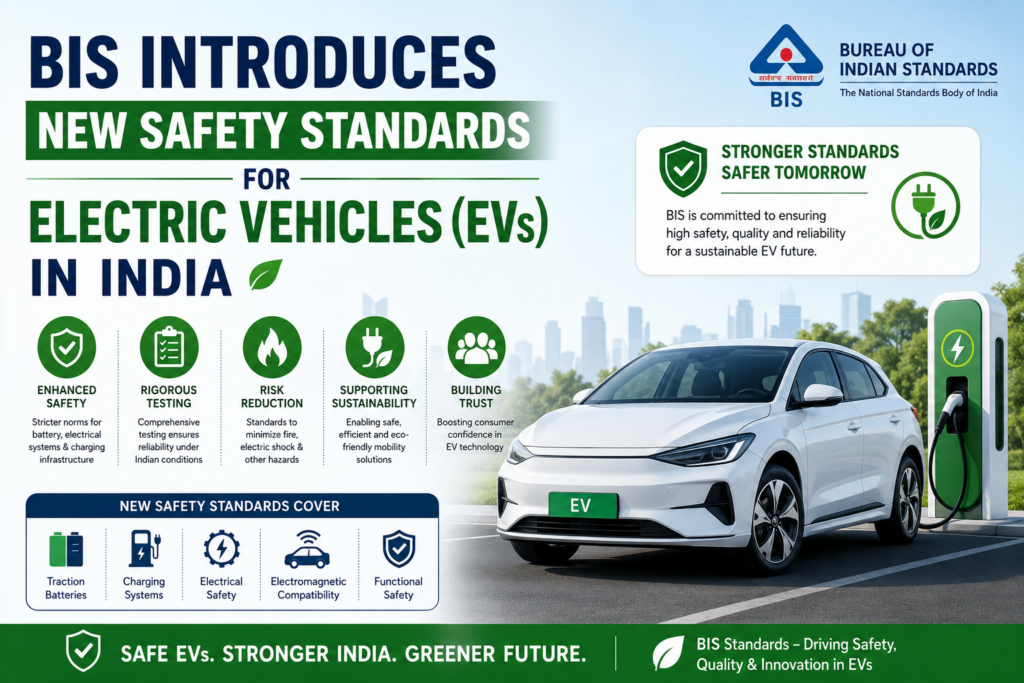
India’s electric vehicle (EV) market is expanding at an unprecedented pace. With growing environmental awareness, government incentives, and advancements in battery technology, electric mobility is becoming a key part of the country’s transportation future. As EV adoption increases, ensuring the safety and reliability of these vehicles has become a critical priority. To address this need, the Bureau of Indian Standards (BIS) has introduced new safety standards for Electric Vehicles (EVs) in India.
These updated standards aim to strengthen consumer protection, improve product quality, and establish a robust framework for manufacturers operating in the EV sector. The move is expected to enhance public confidence in electric vehicles while supporting the long-term growth of the industry.
Why New EV Safety Standards Were Needed
The rapid growth of electric vehicles has brought numerous benefits, including reduced fuel consumption and lower carbon emissions. However, it has also highlighted several safety concerns, particularly related to lithium-ion batteries, charging systems, and electrical components.
Over the past few years, incidents involving battery overheating, thermal runaway, and vehicle fires have raised questions about EV safety. These events emphasized the need for stricter testing procedures and more comprehensive safety regulations.
Recognizing these challenges, BIS introduced enhanced safety requirements to ensure that EVs sold in India meet higher standards of performance, durability, and safety. These measures are designed to reduce risks and provide greater assurance to consumers.
Understanding the Role of BIS
The Bureau of Indian Standards is India’s national standards organization responsible for developing quality and safety benchmarks across various industries. BIS standards help manufacturers maintain consistency, improve product quality, and comply with regulatory requirements.
In the electric vehicle sector, BIS plays an important role in establishing technical specifications for batteries, charging equipment, electrical systems, and vehicle components. The introduction of new EV safety standards reflects BIS’s commitment to supporting safe and sustainable transportation in India.
Major Highlights of the New EV Safety Standards
The new standards focus on several critical areas that directly impact the safety and performance of electric vehicles.
Enhanced Battery Safety Requirements
An electric vehicle’s battery is its fundamental component. . Since lithium-ion batteries store large amounts of energy, they require strict safety measures to prevent failures.
The updated standards require batteries to undergo rigorous testing under different conditions, including:
- High-temperature exposure
- Low-temperature performance
- Mechanical impact resistance
- Vibration testing
- Water ingress protection
- Short-circuit conditions
- Overcharge and discharge testing
These tests help ensure that batteries remain stable and safe during regular use as well as in challenging environments.
Advanced Battery Management Systems
Battery Management Systems (BMS) are responsible for monitoring battery health and maintaining safe operating conditions.
The new BIS standards emphasize the use of advanced BMS technology capable of:
- Monitoring cell voltage
- Controlling battery temperature
- Preventing overcharging
- Detecting abnormal conditions
- Managing battery performance efficiently
A reliable BMS significantly reduces the risk of battery-related incidents and improves the overall lifespan of the vehicle.
Improved Thermal Management
One of the primary causes of battery failures is excessive heat generation. Proper thermal management is essential to maintain battery safety and performance.
The updated standards require manufacturers to implement effective cooling and heat-control systems that prevent overheating during charging, driving, and storage.
This requirement helps minimize the risk of thermal runaway, a condition that can lead to battery fires and severe damage.
Safer Charging Infrastructure
Charging systems are another important aspect of EV safety. Faulty charging equipment or incompatible charging methods can create serious risks.
The new BIS standards introduce guidelines for:
- Safe electrical connections
- Charging connector compatibility
- Overcurrent protection
- Shock prevention measures
- Charging equipment reliability
These measures ensure safer interactions between vehicles and charging stations.
Vehicle-Level Safety Evaluation
Beyond batteries and charging systems, the standards also focus on overall vehicle safety. Manufacturers must conduct extensive testing to verify the reliability of electrical systems, vehicle components, and safety mechanisms.
The evaluation includes:
- Electrical insulation testing
- Environmental performance testing
- Functional safety assessments
- Component durability verification
- Structural integrity analysis
Such comprehensive testing helps ensure that electric vehicles perform safely under various operating conditions.
Benefits for Consumers
The introduction of stricter EV safety standards offers significant advantages for consumers.
Greater Safety Assurance
Customers may be more certain that certified electric cars have passed stringent testing and adhere to safety regulations.
Improved Product Reliability
Vehicles manufactured according to BIS standards are likely to offer better performance, longer battery life, and reduced maintenance issues.
Reduced Risk of Accidents
Enhanced battery protection, thermal management systems, and charging safety measures contribute to a lower risk of electrical failures and fire-related incidents.
Better Value for Investment
Higher-quality vehicles provide better long-term value by reducing repair costs and improving operational efficiency.
Impact on EV Manufacturers
Manufacturers are encouraged to use more sophisticated engineering techniques and stricter quality control procedures by the introduction of new BIS safety regulations.
Companies are now expected to:
- Strengthen product testing procedures
- Improve battery design and performance
- Invest in safety-focused technologies
- Enhance manufacturing quality systems
- Ensure compliance with regulatory requirements
Even while it could cost more to achieve these criteria, doing so gives firms the chance to strengthen their brands and win over customers.
Supporting India’s EV Vision
India has set ambitious goals for electric mobility as part of its efforts to reduce pollution and dependence on fossil fuels. The success of these initiatives depends heavily on consumer confidence and product reliability.
The introduction of new BIS safety standards supports this vision by creating a safer and more dependable EV ecosystem. Strong safety regulations encourage wider adoption of electric vehicles while promoting innovation and technological advancement within the industry.
Conclusion
The decision by BIS to introduce new safety standards for Electric Vehicles (EVs) in India is a significant milestone in the country’s journey toward sustainable mobility. These standards address critical safety concerns related to batteries, charging systems, thermal management, and overall vehicle performance.
By establishing stricter quality benchmarks, BIS is helping manufacturers deliver safer and more reliable electric vehicles to the market. The new regulations not only protect consumers but also strengthen the credibility of the EV industry and support India’s transition to a cleaner, greener transportation future. As electric mobility continues to grow, these safety standards will play a crucial role in ensuring long-term success and public trust in EV technology.