
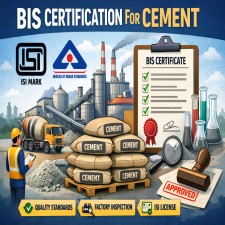
India’s construction industry is expanding rapidly, driven by infrastructure growth, smart cities, highways, housing projects, and industrial development. Cement plays a foundational role in every construction activity. To ensure quality, durability, and public safety, the Government of India has made BIS Certification For Cement mandatory for all manufacturers.
Without proper certification, cement cannot legally be sold in the Indian market. This blog explains the importance, eligibility, licensing steps, and compliance requirements under BIS Certification For Cement, along with expert support options.
Understanding BIS Certification For Cement
BIS Certification For Cement is granted by the Bureau of Indian Standards (BIS) under the mandatory certification scheme. Cement products must conform to specific Indian Standards before being approved.
The certification authorizes manufacturers to use the ISI mark for cement products, which indicates that the product meets prescribed safety and quality standards.
The certification applies to various cement categories including:
- Ordinary Portland Cement (OPC)
- Portland Pozzolana Cement (PPC)
- Portland Slag Cement (PSC)
- Rapid Hardening Cement
- Sulphate Resistant Cement
Each category requires separate compliance under relevant IS codes before obtaining BIS Certification For Cement.
Why BIS Certification is Crucial for Cement Manufacturers
For any cement plant, obtaining BIS certification for cement manufacturers is not optional—it is a legal obligation. The reasons include:
- Ensures structural safety of buildings and infrastructure
- Protects consumers from substandard materials
- Improves brand credibility
- Enables participation in government tenders
- Reduces legal risks
Without a valid BIS license for cement manufacturers, production and sale are illegal under Indian law.
BIS Certification For Cement Products: Scope of Compliance
The BIS certification for cement products ensures:
- Proper chemical composition
- Controlled setting time
- Required compressive strength
- Quality raw material usage
- Standardized packaging and labeling
Once approved, the manufacturer receives a BIS license for cement products, allowing the use of the ISI mark on packaging.
Step-by-Step Process for BIS Certification For Cement Products
The process for BIS certification for cement products involves several technical steps:
1. Application Filing
Submit an application with complete manufacturing details, IS standard selection, and plant information.
2. Document Verification
BIS reviews production capacity, testing facilities, and quality management systems.
3. Factory Inspection
BIS officers conduct an on-site audit to verify:
- Production process
- Raw material storage
- Laboratory equipment
- Testing procedures
4. Sample Collection & Testing
Samples are tested in BIS-recognized laboratories to confirm compliance.
5. Grant of License
Upon successful evaluation, BIS Certification For Cement is granted and the manufacturer can use the ISI mark.
Timelines typically range between 30–60 days depending on preparedness.
Documents Required
For obtaining BIS Certification For Cement, manufacturers must provide:
- Factory registration certificate
- GST certificate
- Plant layout
- List of machinery
- Internal test reports
- Quality control documentation
- Authorized signatory details
Accurate documentation ensures faster approval.
Challenges in BIS Certification For Cement
Many manufacturers face delays due to:
- Incorrect IS standard selection
- Inadequate testing laboratory setup
- Improper documentation
- Non-compliance in sample testing
Professional BIS Consultants in India can help avoid such complications and streamline approvals.
How Indiaxis Supports Cement Manufacturers
For businesses looking for expert compliance support, Indiaxis offers end-to-end assistance in securing BIS Certification For Cement. Their regulatory experts guide manufacturers through:
- IS standard identification
- Documentation preparation
- Inspection readiness
- Sample testing coordination
- License approval tracking
With professional help, cement companies can obtain their BIS license for cement manufacturers smoothly and efficiently.
Benefits of BIS Certification For Cement
Obtaining BIS Certification For Cement offers multiple advantages:
- Legal authorization to operate
- Stronger brand reputation
- Increased dealer and distributor trust
- Eligibility for large infrastructure projects
- Competitive market advantage
Compliance also ensures long-term sustainability in the Indian construction sector.
Frequently Asked Questions (FAQs)
1. Is BIS Certification For Cement compulsory for all manufacturers?
Yes, it is mandatory for manufacturing and selling cement in India.
2. What is the validity of a BIS license?
The license is typically valid for one to two years and must be renewed.
3. Can imported cement be sold without BIS certification?
No, imported cement must also comply with BIS standards.
4. How long does the certification process take?
Usually 30–60 days depending on documentation and inspection readiness.
5. Is factory inspection mandatory?
Yes, BIS conducts a physical inspection before granting approval.
6. What is the role of a BIS Consultant in Delhi?
A BIS Consultant in Delhi assists with documentation, inspection preparation, and approval tracking.
7. Can a manufacturer apply for multiple cement grades under one license?
Each grade may require separate compliance under applicable IS standards.