
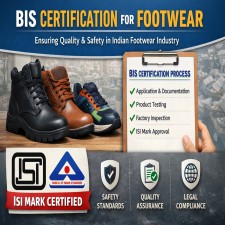
The Indian footwear market is witnessing rapid growth, driven by rising consumer demand and expanding manufacturing capabilities. To regulate quality and ensure consumer safety, the government has made BIS certification for footwear mandatory for specific product categories. This certification helps standardize manufacturing practices and ensures that footwear sold in India meets prescribed safety and performance norms.
What Is BIS Certification for Footwear?
BIS certification for footwear is a conformity assessment issued by the Bureau of Indian Standards under the relevant Quality Control Orders. It confirms that footwear products comply with notified Indian Standards and are safe for consumer use. Once approved, manufacturers are authorized to use the ISI mark for footwear, which is a symbol of quality and compliance.
The regulation applies to Indian manufacturers as well as foreign manufacturers exporting footwear to India.
Importance of BIS Footwear Certification in the Indian Market
Footwear is a product of daily use, and low-quality materials or weak construction can lead to injuries and discomfort. BIS footwear certification ensures that manufacturers follow standardized production processes, use approved materials, and maintain consistent quality.
From a business perspective, footwear BIS certification in India helps brands build trust, avoid legal risks, and gain access to organized retail and government procurement channels.
Footwear Products Covered Under BIS Certification
As per the notified rules, several categories must obtain BIS certification for footwear, including:
- Safety and industrial footwear
- Rubber and PVC footwear
- Leather footwear for occupational use
- Protective footwear used in hazardous environments
Each category is governed by specific BIS standards for footwear, which define performance, durability, and safety benchmarks.
Key BIS Standards for Footwear
Some of the commonly applicable standards include:
- IS 15298 – Safety, protective, and occupational footwear
- IS 5676 – Rubber footwear
- IS 17043 – PVC footwear
Compliance with these BIS standards for footwear is essential for obtaining the BIS license for footwear and maintaining certification validity.
Step-by-Step BIS Certification Process
The BIS certification for the footwear process involves technical evaluation and regulatory approval:
- Application Submission
Manufacturers submit an online application for BIS registration for footwear along with the required technical details. - Sample Testing
Footwear samples are tested at BIS-recognized laboratories to verify compliance with applicable standards. - Factory Inspection
BIS officials inspect the manufacturing facility to assess production capability, testing infrastructure, and quality control systems. - Grant of BIS License
After a successful evaluation, the BIS license for footwear is issued, allowing use of the ISI mark. - Surveillance and Renewal
Ongoing compliance is ensured through periodic audits and testing.
Documentation Required for BIS Certification for Shoes
To obtain BIS certification for shoes, manufacturers must prepare:
- Factory incorporation and address proof
- Manufacturing process flowchart
- Quality control procedures
- Test equipment calibration records
- Product test reports
- Authorization documents
Proper documentation plays a critical role in smooth approval.
Role of BIS Consultant for Footwear Manufacturers
Due to evolving regulations and technical testing requirements, many businesses prefer working with a professional BIS consultant for footwear. A consultant helps in:
- Identifying applicable IS standards
- Coordinating laboratory testing
- Managing BIS inspections
- Preparing accurate applications
- Reducing delays and rejections
This support becomes especially important for first-time applicants.
How Indiaxis Supports BIS Approval
Indiaxis offers specialized compliance and certification support for manufacturers seeking BIS approval for footwear. With expertise in Indian regulatory frameworks, Indiaxis assists businesses at every stage—from initial assessment to final licensing.
Their structured approach ensures faster processing, reduced compliance risks, and seamless implementation of BIS certification for footwear requirements.
Benefits of BIS Certification for Footwear Businesses
Securing BIS certification for footwear provides multiple advantages:
- Legal authorization to sell in India
- Increased consumer confidence
- Improved product quality and safety
- Eligibility for institutional and government buyers
- Protection from regulatory penalties
The ISI mark for footwear acts as a visible assurance of quality and compliance.
Consequences of Non-Compliance
Manufacturers or importers selling footwear without a valid ISI certification for footwear may face:
- Heavy financial penalties
- Product seizure or recall
- Ban on sale or import
- Legal action under the BIS Act
Therefore, timely BIS registration for footwear is critical for business continuity.
Frequently Asked Questions (FAQs)
Q1. Who needs BIS certification for footwear in India?
Manufacturers and importers of notified footwear categories must obtain BIS certification for footwear.
Q2. Is BIS certification required for shoes imported into India?
Yes, imported footwear must comply with the BIS certification for shoes norms.
Q3. What is the validity period of a BIS license for footwear?
The license is usually valid for 1–2 years and is renewable.
Q4. Can a single BIS license cover multiple footwear models?
Yes, provided all models comply with the same Indian Standard.
Q5. Is ISI marking mandatory after certification?
Yes, affixing the ISI mark for footwear is compulsory.