
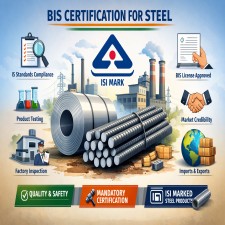
India’s rapidly growing infrastructure and manufacturing sectors rely heavily on quality steel and steel products. To regulate standards and ensure safety, the Bureau of Indian Standards (BIS) mandates the BIS certification for steel for selected steel products. This certification not only ensures regulatory compliance but also builds credibility for manufacturers in the Indian market.
Overview of BIS Certification for Steel
BIS certification for steel is a conformity assessment process that verifies whether steel products comply with Indian Standards (IS). These standards specify technical parameters related to strength, composition, and performance.
Steel manufacturers must obtain BIS approval before selling their products in India. This certification applies to both domestic and imported steel products.
Importance of BIS for Steel Products
BIS certification is crucial due to the extensive use of steel in construction, transportation, engineering, and industrial manufacturing. BIS for steel products ensures:
- Structural safety and durability
- Consistent quality across batches
- Protection against substandard materials
- Compliance with government regulations
Manufacturers without certification risk legal penalties and loss of market access.
Key BIS Steel IS Standards Applicable
Different steel products must comply with specific BIS steel IS standards, such as:
- IS 1786 for high-strength deformed steel bars
- IS 2062 for structural steel
- IS 277 for galvanized steel sheets
- IS 6911 for stainless steel plate and sheet
These standards outline mechanical properties, chemical composition, and testing methods that manufacturers must follow.
Understanding the BIS Process Steel Certification
The BIS process steel certification follows a structured approach:
- Online Application Filing
Manufacturers submit detailed product and factory information. - Product Testing
Steel samples are tested at BIS-recognized laboratories. - Factory Assessment
BIS officials conduct an on-site inspection to verify production and quality systems. - License Granting
After a successful evaluation, the BIS license is issued. - Ongoing Surveillance
Periodic audits ensure continuous compliance.
This process ensures that certified steel products maintain quality throughout their lifecycle.
BIS Compliance for Manufacturers in the Steel Sector
Achieving BIS compliance for manufacturers requires a strong internal quality framework. Key requirements include:
- Standardized manufacturing procedures
- In-house or approved external testing facilities
- Proper calibration of equipment
- Traceable raw material sourcing
- Skilled technical staff
Manufacturers must maintain compliance even after certification to avoid suspension.
How Indiaxis Supports BIS Certification for Steel
Indiaxis provides specialized consulting services for BIS certification for steel, guiding manufacturers at every stage. Their services include:
- Identifying applicable BIS standards
- Documentation preparation and verification
- Coordination with BIS authorities
- Assistance during factory inspections
- Post-certification compliance support
With Indiaxis, manufacturers can significantly reduce certification timelines and compliance risks.
Steel Certification India – Business Advantages
Obtaining steel certification in India offers multiple business benefits:
- Authorization to sell steel products legally
- Improved brand reputation and trust
- Eligibility for government tenders
- Competitive advantage in domestic markets
- Reduced risk of regulatory penalties
Certified manufacturers are preferred partners for large-scale infrastructure projects.
Common Errors to Avoid During BIS Certification
Manufacturers often face rejection due to:
- Incomplete or incorrect documentation
- Non-compliance with BIS steel IS standards
- Poor quality control systems
- Unprepared factory audits
Professional consultancy support helps eliminate these issues and ensures smoother approvals.
Conclusion
BIS certification for steel is a vital requirement for manufacturers aiming for quality assurance and regulatory compliance in India. From understanding BIS for steel products to completing the BIS process for steel and maintaining BIS compliance for manufacturers, every step demands careful execution.
With expert assistance from Indiaxis, steel manufacturers can achieve certification efficiently and confidently.
FAQs – BIS Certification for Steel
Q1. Which steel products require BIS certification in India?
Steel bars, structural steel, sheets, and other notified products require BIS certification.
Q2. How long is a BIS steel license valid?
Typically, the BIS license is valid for one to two years and must be renewed.
Q3. Are BIS steel IS standards mandatory?
Yes, compliance with applicable IS standards is compulsory for certified products.
Q4. Can BIS certification for steel be transferred?
No, BIS licenses are non-transferable and linked to a specific manufacturing unit.
Q5. What is the cost of BIS certification for steel?
Costs depend on product type, testing fees, and license charges.
Q6. Is factory inspection mandatory in the BIS process for steel?
Yes, BIS officials conduct factory inspections before granting certification.
Q7. Can a consultant help with BIS compliance for manufacturers?
Yes, professional consultants streamline documentation and compliance management.