
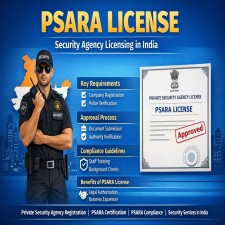
The demand for professional security services in India has increased significantly due to rapid urbanization, infrastructure growth, and rising safety concerns. Residential societies, corporate offices, warehouses, hospitals, and shopping complexes all rely on trained security personnel to maintain safety and prevent unauthorized access. However, before starting a private security agency, it is legally mandatory to obtain a PSARA License.
The PSARA certificate is issued under the Private Security Agencies Regulation Act, 2005. This law was implemented by the Government of India to regulate private security agencies and ensure that they operate according to established guidelines and professional standards.
Without proper authorization, running a security agency is illegal. Therefore, businesses must follow the PSARA approval process and ensure full PSARA compliance before providing security services.
This blog explains everything you need to know about PSARA approval, including the registration process, benefits, required documents, compliance requirements, and how consultants like Indiaxis assist in obtaining the license smoothly.
What is the PSARA License?
A PSARA License is a government-issued authorization that allows companies to operate as private security agencies in India. The license ensures that security companies follow legal regulations and employ trained personnel.
The PSARA framework was introduced to regulate the rapidly growing private security industry and ensure that agencies provide professional and reliable services.
The PSARA License is granted by the Controlling Authority of the respective state government. Each state has its own procedures and requirements under the Security Agency Licensing India framework.
Obtaining this license confirms that the agency has completed the Private Security Agency Registration process and meets the standards required by law.
Why PSARA License is Important for Security Agencies
Obtaining a PSARA License provides several benefits for businesses operating in the private security sector.
- Legal Authorization
The PSARA certification allows companies to legally operate security services in India without facing legal issues.
- Professional Credibility
Licensed agencies gain credibility among corporate clients and government organizations.
- Compliance with Government Regulations
The license ensures that agencies meet all PSARA compliance requirements including training, background verification, and operational guidelines.
- Client Confidence
Clients prefer working with agencies that have PSARA certification because it ensures trained and verified security personnel.
- Business Growth Opportunities
A valid PSARA License enables companies to expand their services and participate in large security contracts.
PSARA Approval Process
The PSARA approval process involves several steps that security agencies must follow before receiving the license.
Step 1: Company Formation
The first step is to register the company as a legal entity such as:
- Private Limited Company
- Partnership Firm
- LLP
- Sole Proprietorship
This step is essential for initiating the Private Security Agency Registration.
Step 2: Agreement with Training Institute
Security guards must undergo professional training. Agencies must sign a Memorandum of Understanding with a government-approved training institute.
Step 3: Police Verification
Police verification is conducted for the directors, promoters, and key personnel involved in the agency.
Step 4: Application Filing
The application for PSARA License is submitted to the state controlling authority along with required documents.
Step 5: Document Verification
Authorities review the documents and verify whether the agency fulfills all PSARA compliance requirements.
Step 6: License Issuance
After successful verification, the state government issues the PSARA License allowing the agency to start operations.
Many companies seek assistance from professional consultants like Indiaxis to complete the Security Agency Licensing India process efficiently.
Documents Required for PSARA License
Proper documentation plays a critical role in obtaining a PSARA License. Some of the key documents include:
- Certificate of company registration
- PAN card of the business entity
- Identity proof of directors or partners
- Office address proof
- Affidavit as required under PSARA rules
- MOU with a training institute
- Police verification certificates
- GST registration details
- Passport size photographs of directors
Submitting accurate documents helps speed up the PSARA approval process.
PSARA Compliance for Security Agencies
After receiving the PSARA License, security agencies must follow strict compliance guidelines to maintain their authorization.
Key PSARA compliance requirements include:
- Hiring trained security guards
- Conducting proper background verification of employees
- Maintaining employee records and training certificates
- Providing uniforms and identity cards
- Ensuring proper supervision and monitoring
- Maintaining operational transparency
Non-compliance with these requirements may result in penalties or suspension of the PSARA License.
Role of Consultants in PSARA License Registration
Obtaining a PSARA License involves multiple legal steps and documentation requirements. Professional consultants help businesses complete the process smoothly.
Consultancy firms such as Indiaxis assist with:
- Preparation of application documents
- Guidance on PSARA certification requirements
- Coordination with training institutes
- Handling police verification procedures
- Ensuring full PSARA compliance
Their expertise simplifies the Security Agency Licensing India process and helps agencies obtain the license without delays.
Conclusion
The private security sector in India is expanding rapidly, creating opportunities for entrepreneurs to start security agencies. However, compliance with legal regulations is essential before entering the market.
A PSARA License is mandatory for operating a private security agency in India. The license ensures that security companies follow professional standards, train their personnel properly, and maintain transparency in their operations.
By completing the PSARA approval process and maintaining proper PSARA compliance, businesses can build a trusted security service brand. With professional support from consultants like Indiaxis, the Private Security Agency Registration process becomes easier and more efficient.
FAQs on PSARA License
1. What is the PSARA License in India?
A PSARA License is a legal authorization required to start and operate a private security agency under the Private Security Agencies Regulation Act.
2. Is PSARA License mandatory for security agencies?
Yes, it is mandatory. No company can legally provide security guard services without a PSARA License.
3. How long does the PSARA approval process take?
The PSARA approval process generally takes around 2–3 months depending on the state government authority.
4. Who issues the PSARA License?
The PSARA License is issued by the Controlling Authority appointed by the respective state government.
5. What is the validity of the PSARA License?
The license validity varies from state to state and may range from 1 year to 5 years.
6. Can a company operate in multiple states with one PSARA License?
No, separate PSARA License applications must be submitted for each state.
7. Can consultants help with PSARA registration?
Yes, professional consultants help businesses complete the Private Security Agency Registration and ensure compliance with PSARA regulations.