
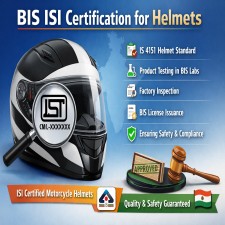
In India, helmets are a mandatory safety accessory for two-wheeler riders, and their quality directly impacts road safety. To regulate helmet quality, the Bureau of Indian Standards (BIS) mandates BIS ISI certification for helmets before they are sold in the Indian market. This certification ensures that helmets meet stringent safety, durability, and performance benchmarks laid down under Indian standards.
Manufacturers aiming for legal compliance and consumer trust must understand the certification framework. With expert assistance from Indiaxis, the helmet certification journey becomes structured and hassle-free.
Understanding BIS ISI Certification for Helmets
BIS ISI certification for helmets is a compulsory certification scheme that validates whether a helmet conforms to Indian safety norms. Helmets approved under this system carry the ISI mark, which confirms compliance with the IS 4151 helmet standard.
The certification applies to:
- Motorcycle helmets
- Scooter helmets
- Protective headgear for two-wheelers
Without BIS ISI certification for helmets, selling or distributing helmets in India is considered a legal offense.
Importance of ISI Certification for Helmets
The rise in counterfeit and low-quality helmets has raised serious safety concerns. ISI certification for helmets addresses these risks by enforcing standardized testing and quality checks.
Key reasons why certification is essential:
- Protects riders from head injuries
- Ensures product reliability during accidents
- Eliminates unsafe helmet products from the market
- Strengthens manufacturer credibility
Helmets bearing the ISI mark for helmets are trusted by consumers and law enforcement authorities alike.
IS 4151 Helmet Standard Explained
The IS 4151 helmet standard is the governing benchmark for helmet certification in India. It specifies requirements related to:
- Energy absorption capability
- Resistance to penetration
- Retention system effectiveness
- Chin strap durability
- Clear and adequate field of vision
Compliance with BIS standards for helmets ensures uniform safety performance across all certified products.
Helmet ISI Certification Process in India
The helmet ISI certification process is systematic and involves technical scrutiny. Below is a simplified overview:
- Application to BIS
Manufacturers apply for certification with detailed product and factory information. - Sample Testing
Helmet samples are tested in BIS-recognized laboratories according to IS 4151. - Factory Evaluation
BIS officials inspect production units to verify manufacturing and quality control practices. - Grant of BIS License
Once all requirements are met, a BIS license is issued. - Ongoing Surveillance
Certified manufacturers are subject to periodic audits and sample testing.
Obtaining BIS ISI certification for helmets requires accuracy and adherence to technical norms at every stage.
How Indiaxis Supports Helmet Manufacturers
Indiaxis is a professional compliance consultancy assisting manufacturers in achieving BIS approval for helmets efficiently. Their expert services include:
- BIS application filing
- Laboratory coordination for product testing
- Factory inspection preparation
- Documentation and compliance management
- Post-certification surveillance support
With Indiaxis, manufacturers can secure BIS ISI certification for helmets without unnecessary delays or rejections.
BIS License for Helmet Manufacturers
A BIS license for helmet manufacturers authorizes the use of the ISI mark on certified products. This license demonstrates that the manufacturer complies with national safety regulations and quality benchmarks.
Benefits include:
- Legal access to Indian markets
- Improved brand credibility
- Acceptance in government and institutional tenders
- Reduced risk of penalties and recalls
Manufacturers holding this license can confidently market ISI-certified motorcycle helmets across India.
Consumer Trust and Market Advantage
Consumers today are increasingly aware of helmet safety standards. Helmets with Helmet ISI certification are preferred due to:
- Proven safety performance
- Compliance with Indian regulations
- Long-term durability
From a business perspective, BIS ISI certification for helmets enhances product acceptance, boosts sales, and strengthens brand positioning.
Frequently Asked Questions (FAQ)
Q1. Is BIS ISI certification for helmets mandatory in India?
Yes, all helmets sold in India must have a valid ISI certification.
Q2. Which Indian standard applies to helmet certification?
The applicable standard is IS 4151 helmet standard.
Q3. Who can apply for helmet ISI certification?
Manufacturers and importers of helmets can apply through BIS.
Q4. What happens if helmets are sold without the ISI mark?
Selling non-certified helmets can lead to fines, product seizure, and legal action.
Conclusion
BIS ISI certification for helmets plays a critical role in ensuring rider safety and maintaining product quality in India. Compliance with BIS standards for helmets not only fulfills legal obligations but also builds consumer confidence. With expert support from Indiaxis, manufacturers can navigate the helmet ISI certification process smoothly and gain a strong foothold in the Indian helmet market.