
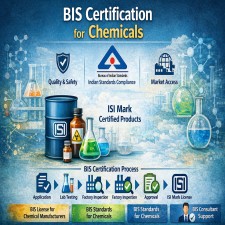
India’s chemical industry is one of the fastest-growing sectors, contributing significantly to manufacturing, exports, and employment. However, due to the sensitive nature of chemical products, regulatory compliance is strictly enforced. BIS certification for chemicals is a crucial requirement that ensures chemical products meet Indian safety, quality, and performance standards before being sold in the market.
Professional consulting firms like Indiaxis help chemical manufacturers understand regulatory obligations and obtain BIS approval smoothly, minimizing compliance risks.
What Is BIS Certification for Chemicals?
BIS certification for chemicals is a conformity assessment issued by the Bureau of Indian Standards. It confirms that chemical products adhere to specific Indian Standards (IS) related to composition, purity, safety, and labeling.
This BIS certification for chemicals protects consumers, industries, and the environment by ensuring only compliant chemicals are manufactured and distributed within India.
Importance of BIS Certification in the Chemical Industry
Chemical products are widely used across sectors such as pharmaceuticals, agriculture, textiles, paints, construction, and water treatment. Non-compliance can lead to safety hazards and legal consequences. Key benefits of BIS compliance for chemicals include:
- Legal authorization to manufacture and sell chemicals in India
- Improved product reliability and safety assurance
- Higher acceptance in B2B and government procurement
- Strengthened domestic and international market reputation
For many categories, BIS approval for chemicals is mandatory under Indian law.
Scope of BIS Certification for Industrial Chemicals
BIS certification for industrial chemicals applies to products used in large-scale manufacturing and processing units. These chemicals must comply with specific IS standards related to:
- Chemical properties
- Hazard classification
- Storage and transportation norms
- Quality consistency
Failure to comply may result in penalties, product bans, or license cancellation.
BIS Standards for Chemicals Explained
BIS standards for chemicals are developed through technical committees and expert consultations. These standards specify:
- Chemical composition limits
- Test methods
- Quality benchmarks
- Packaging and marking requirements
Manufacturers must strictly adhere to these standards to qualify for certification.
ISI Mark for Chemicals
Once a chemical product meets all BIS requirements, the manufacturer is authorized to affix the ISI mark for chemicals. This mark signifies:
- Compliance with Indian Standards
- Product safety and reliability
- Government-recognized quality assurance
The ISI mark is especially important for chemicals supplied to public sector units and infrastructure projects.
BIS Certification Process for Chemicals
The BIS certification process for chemicals involves multiple technical and administrative steps:
- Standard Identification
Determine the applicable IS standard for the chemical product. - Application Filing
Apply along with test reports, manufacturing details, and quality manuals. - Factory Audit
BIS officials inspect the manufacturing unit to assess quality control systems and production capabilities. - Sample Testing
Samples are sent to BIS-recognized labs for conformity testing. - Grant of BIS License
Upon successful evaluation, BIS issues the certification license.
Each stage requires careful coordination and compliance accuracy.
BIS License for Chemical Manufacturers
A BIS license for chemical manufacturers authorizes a specific manufacturing unit to produce certified chemical products. Manufacturers must:
- Maintain consistent production quality
- Follow approved testing procedures
- Allow periodic BIS surveillance inspections
Non-compliance can result in suspension or revocation of the license.
BIS Registration for Chemicals vs Certification
Many manufacturers confuse BIS registration for chemicals with certification. The difference lies in the applicable scheme:
- Certification under the ISI Mark Scheme is common for chemicals
- Registration applies to specific product categories under the BIS schemes
Choosing the wrong pathway may cause delays or rejection.
Why Choose a BIS Consultant for Chemical Certification?
Due to technical documentation, testing protocols, and audits, hiring a BIS consultant for chemical certification is highly recommended. Consultants assist with:
- Regulatory interpretation
- Documentation and application accuracy
- Factory inspection preparedness
- Faster approval timelines
Firms like Indiaxis specialize in end-to-end BIS consulting services for chemical manufacturers across India.
Common Challenges in BIS Approval for Chemicals
Manufacturers often face issues such as:
- Incorrect standard mapping
- Inadequate in-house testing facilities
- Non-compliance during factory inspection
- Delays in laboratory test reports
Expert guidance significantly reduces these challenges and ensures smooth BIS approval for chemicals.
Conclusion
In an increasingly regulated manufacturing environment, BIS certification for chemicals is essential for ensuring safety, quality, and legal compliance. From meeting BIS standards for chemicals to securing the ISI mark, every step must be handled with precision.
With professional support from consultants like Indiaxis, chemical manufacturers can streamline certification, reduce compliance risks, and strengthen their market presence.
FAQ – BIS Certification for Chemicals
Q1. Is BIS certification mandatory for industrial chemicals?
Yes, many industrial chemicals must comply with BIS standards before market entry.
Q2. How long does it take to obtain BIS certification for chemicals?
The process generally takes 3–6 months, depending on testing and inspection timelines.
Q3. Can imported chemicals require BIS certification?
Yes, certain imported chemicals must also comply with BIS norms.
Q4. Is BIS certification renewed periodically?
Yes, BIS licenses are subject to renewal and regular surveillance audits.