
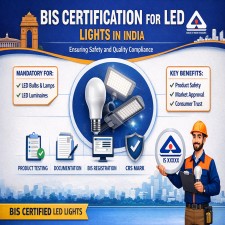
India’s transition toward energy-efficient lighting has made LED products an essential part of residential, commercial, and industrial infrastructure. To ensure safety, performance, and quality, the government has made BIS certification for LED lights compulsory under the Compulsory Registration Scheme (CRS). Manufacturers and importers must comply with these standards before introducing LED products into the Indian market.
This blog explains the regulatory framework, certification process, and how compliance experts like Indiaxis support businesses in achieving seamless BIS approval.
Understanding BIS Certification for LED Products
The Bureau of Indian Standards (BIS) regulates LED products to ensure they meet Indian safety and performance benchmarks. BIS certification for LED lights confirms that products have been tested in BIS-recognized laboratories and comply with applicable Indian Standards.
LED products covered under CRS include:
- LED bulbs
- LED lamps and luminaires
- LED modules
- LED drivers
Without proper BIS certification for LED Lights, these products cannot be legally sold or imported in India.
Applicable Standards for LED Lights
Some commonly applicable standards for LED products include:
- IS 16102 (Self-ballasted LED lamps)
- IS 16103 (LED modules for general lighting)
- IS 10322 (Luminaires)
Compliance with these standards is mandatory for obtaining BIS approval for LED lights.
Who Needs BIS Registration?
The following entities must obtain certification:
- Indian LED manufacturers
- Foreign LED manufacturers exporting to India
- Brand owners selling LED products in India
Importers and distributors must ensure that the manufacturer holds a valid BIS registration for LED bulbs and lighting products.
BIS CRS Registration Process for LED Lights
The BIS CRS registration for LED lights involves a systematic approval process:
Step 1: Product Testing
LED samples are tested at BIS-recognized laboratories against applicable standards.
Step 2: Documentation
Manufacturers compile documents such as factory details, test reports, and authorization letters.
Step 3: Online Submission
The application is submitted through the BIS CRS portal.
Step 4: Review & Verification
BIS reviews the application and may request clarifications.
Step 5: Grant of Registration
Upon approval, a BIS registration number is issued, allowing the use of the CRS mark.
With professional assistance, this process becomes faster and error-free.
Importance of BIS License for LED Manufacturers
A BIS license for LED manufacturers offers several advantages:
- Legal access to the Indian market
- Improved brand credibility
- Enhanced consumer trust
- Mandatory clearance at Indian customs
- Eligibility for government and bulk tenders
Manufacturers without a BIS license risk penalties, product recalls, and business disruptions.
BIS License for LED Lights and Market Compliance
Holding a valid BIS Certification for LED lights is not only a regulatory requirement but also a strategic business advantage. Certified LED products are preferred by retailers, e-commerce platforms, and institutional buyers due to assured quality and safety.
How Indiaxis Supports BIS Certification
Regulatory procedures can be complex, especially for new or overseas manufacturers. Indiaxis provides comprehensive BIS certification services, ensuring smooth and timely approvals.
Indiaxis offers:
- Product applicability assessment
- Coordination with BIS-approved test labs
- Documentation and application filing
- Follow up with BIS authorities
- Renewal and post-certification support
Their structured approach minimizes delays and ensures compliance with BIS certification for LED lights requirements.
Common Mistakes to Avoid
Manufacturers often face issues such as:
- Selecting incorrect BIS standards
- Submitting incomplete documentation
- Errors in test reports
- Delays in responding to BIS queries
Working with experienced consultants helps prevent these challenges.
FAQs on BIS Certification for LED Lights
Q1. Is BIS certification mandatory for all LED lights in India?
Yes, LED lights covered under CRS require mandatory BIS registration.
Q2. How long does BIS registration take?
Typically, 4–6 weeks, depending on testing and document accuracy.
Q3. Can BIS certification be transferred to another brand?
No, BIS registration is non-transferable.
Q4. Is BIS certification required for imported LED bulbs?
Yes, imported LED products must comply with BIS regulations.
Q5. What is the validity of BIS CRS registration?
BIS CRS registration is generally valid for two years.
Conclusion
Obtaining BIS certification for LED lights is essential for regulatory compliance, product safety, and sustainable business growth in India. From testing to final approval, every step must align with BIS guidelines. With expert support from Indiaxis, manufacturers and importers can achieve certification efficiently and confidently while avoiding costly compliance errors.