
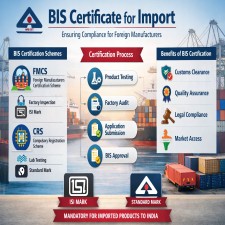
India has strict quality control laws to regulate the inflow of foreign-manufactured goods. One of the most important regulatory approvals required is the BIS Certificate for Import. Certified by the Bureau of Indian Standards (BIS), this certification ensures that imported products meet Indian safety and quality standards before entering the market.
For businesses planning to import goods into India, understanding BIS regulations is essential. Professional compliance service providers such as Indiaxis assist importers and foreign manufacturers in navigating BIS Certification requirements efficiently and lawfully.
Understanding the BIS Certificate for Import
A BIS Certificate for Import is mandatory for specific product categories notified by the Government of India. This certificate confirms that the imported product meets relevant Indian Standards (IS) and is safe for use in India.
The certification applies to:
- Finished imported products
- Foreign-manufactured goods sold under Indian brands
- High-risk products impacting safety, health, or the environment
BIS Certification for Imports is enforced at customs, and uncertified products are not allowed to clear customs.
BIS Certification Schemes for Imported Products
The BIS authority operates different schemes depending on the product nature and risk category.
1. BIS FMCS – Foreign Manufacturers Certification Scheme
BIS FMCS applies when foreign manufacturers want to export regulated products to India. Under this scheme:
- The manufacturer applies directly to BIS
- Factory inspection is mandatory
- Product samples are tested in BIS-recognized labs
- Approved products carry the ISI Mark
This scheme is commonly used for steel products, construction materials, and industrial goods.
2. BIS CRS – Compulsory Registration Scheme
BIS CRS applies mainly to electronic and IT products. Under CRS:
- Products are tested in BIS-approved laboratories
- No factory inspection is required
- Registration is granted based on test reports
- Products carry the Standard Mark
Products Covered Under BIS Certification for Import
Several product categories require BIS Registration for Import, including:
- Electrical appliances
- Electronic devices
- Cement and steel products
- Toys and safety equipment
- Automotive components
- Household and industrial goods
Importers must verify product applicability before shipment to avoid regulatory violations.
Step-by-Step BIS Certificate for Import Process
Obtaining a BIS Certificate for Import involves multiple stages:
- Identification of applicable Indian Standard
- Selection of certification scheme (FMCS or CRS)
- Product testing in BIS-recognized laboratories
- Factory audit (for FMCS cases)
- Preparation of technical and legal documentation
- Online application submission
- Grant of BIS Certification
- Use of ISI Mark or Standard Mark
Each step requires accuracy, as errors may cause delays or rejection.
Importance of BIS Registration for Importers
BIS Certification is not only a legal requirement but also a strategic advantage. It ensures:
- Smooth customs clearance
- Legal authorization to sell products in India
- Protection from penalties and seizures
- Improved brand credibility
- Consumer trust in product quality
Without BIS ISI Certification for imported products, importers face significant business risks.
Role of BIS Certification Consultants
The BIS approval framework is technical and document-intensive, especially for foreign manufacturers. A professional BIS Certification Consultant helps importers by:
- Interpreting Indian Standards
- Coordinating product testing
- Managing factory inspection processes
- Filing BIS Registration applications
- Ensuring post-certification compliance
Consultants like Indiaxis specialize in handling complex BIS Certification for Import cases with precision and efficiency.
ISI Mark and Standard Mark for Imported Goods
The ISI Mark indicates compliance under FMCS, while the Standard Mark applies to CRS-certified products. These marks demonstrate that the product meets Indian quality norms.
Benefits include:
- Mandatory acceptance at customs
- Nationwide market access
- Enhanced product reliability perception
- Compliance with Indian regulatory laws
For many regulated products, ISI Registration for Import is compulsory.
Why Choose Indiaxis for BIS Certification for Import
Indiaxis is a trusted BIS Registration consultant offering comprehensive compliance solutions. Their expertise includes:
- BIS Certification for Foreign Manufacturers
- BIS FMCS and BIS CRS approvals
- End-to-end documentation handling
- Liaison with BIS authorities
- Faster certification turnaround
Their structured compliance approach reduces risk and ensures successful certification outcomes.
Conclusion
Obtaining a BIS Certificate for Import is a critical requirement for importing regulated products into India. With strict enforcement and technical standards, professional assistance becomes essential. By partnering with expert consultants like Indiaxis, importers can ensure regulatory compliance, faster approvals, and uninterrupted access to the Indian market.
FAQs
1. Who can apply for BIS Certification for Import?
Foreign manufacturers apply directly, while importers act as Authorized Indian Representatives.
2. Is factory inspection mandatory for BIS Certification?
Yes, under BIS FMCS, factory inspection is compulsory.
3. What is BIS CRS used for?
BIS CRS is mainly applicable to electronic and IT products.
4. Can one BIS Certificate cover multiple products?
No, each product model requires a separate BIS Registration.
5. What is the role of the ISI Mark in imports?
The ISI Mark indicates compliance with Indian Standards and is mandatory for many imported products.
6. How long does the BIS Certification for Import take?
Timelines vary but typically range from 3 to 6 months.
7. Can BIS Certification be cancelled?
Yes, non-compliance or misuse of certification can lead to suspension or cancellation.