
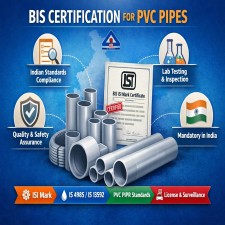
PVC pipes are essential components in water distribution, irrigation, drainage, and industrial infrastructure across India. To ensure safety, durability, and uniform quality, manufacturers must obtain BIS Certification for PVC Pipes before placing their products on the market. This certification confirms compliance with Indian quality norms laid down by the Bureau of Indian Standards (BIS).
This blog offers a detailed overview of standards, procedures, and regulatory requirements, with industry support insights from Indiaxis.
Understanding BIS Certification for PVC Pipes
BIS Certification for PVC Pipes is a mandatory approval that allows manufacturers to use the ISI mark, indicating conformity with prescribed Indian Standards. BIS evaluates parameters such as tensile strength, pressure rating, wall thickness, impact resistance, and chemical composition.
Once certified, manufacturers receive the BIS ISI Mark Certificate for PVC pipe, ensuring market acceptance and regulatory compliance nationwide.
Indian Standards for PVC Pipe Compliance
Different PVC piping applications are governed by specific standards. The most commonly applicable Indian Standards for PVC pipe include:
- IS 4985 – uPVC pipes for potable water supply
- IS 13592 – PVC pipes for sewer and drainage
- IS 12235 (Part 8) – PVC PIPR Standards for irrigation pipelines
- IS 15328 – Sewerage and drainage PVC pipes
- IS 15778 – CPVC pipes for hot and cold water
For flexible applications, BIS Certification for Flexible polyvinyl chloride pipes applies under separate material and performance guidelines.
Scope of Products Covered Under BIS
BIS certification applies to a wide range of PVC products, including:
- Rigid uPVC pressure pipes
- Flexible polyvinyl chloride pipes
- Agricultural and irrigation PVC pipes
- Sewer and waste discharge pipes
- Industrial fluid transport pipes
Many businesses use the term BIS for PVC Pipe, but BIS strictly certifies PVC-based products meeting approved IS specifications.
Why BIS Certification is Crucial for Manufacturers
Obtaining BIS Certification for PVC Pipes provides several strategic and legal advantages:
- Mandatory legal compliance in India
- Enhanced product reliability and consumer confidence
- Increased acceptance in government and PSU projects
- Reduced risk of penalties and product recalls
- Stronger brand positioning in competitive markets
Without BIS certification, PVC pipe manufacturers risk non-compliance penalties and sales restrictions.
BIS Certification Process Explained
The BIS certification procedure includes multiple compliance stages:
1. Application Filing
Submission of Form V with technical details, manufacturing capability, and quality control data.
2. Sample Testing
Product samples are tested in BIS-recognized laboratories against applicable PVC PIPE Standards and Indian norms.
3. Factory Audit
BIS officials inspect the manufacturing facility to verify quality systems, testing equipment, and production consistency.
4. License Grant
Upon successful assessment, BIS grants permission to use the BIS ISI Mark Certificate for PVC pipe.
5. Ongoing Surveillance
Regular audits and sample testing ensure continuous compliance.
Documents Required for BIS Certification
Manufacturers must submit the following:
- Factory registration certificate
- Quality control manual
- Raw material test reports
- In-house testing details
- Product drawings and specifications
- Authorized signatory identification
How Indiaxis Supports BIS Compliance
Indiaxis provides professional assistance throughout the BIS certification lifecycle, including:
- Applicable standard identification
- Documentation preparation
- Lab testing coordination
- Factory inspection readiness
- Post-certification compliance support
Their structured approach helps manufacturers achieve faster approvals with minimal regulatory hurdles.
Conclusion
Achieving BIS Certification for PVC Pipes is essential for manufacturers aiming to operate legally and competitively in India. Understanding the applicable standards, testing requirements, and certification process ensures smooth compliance. With expert support from Indiaxis, businesses can streamline certification and focus on delivering high-quality PVC piping solutions.
FAQs – BIS Certification for PVC Pipes
Q1. Is BIS certification mandatory for PVC pipes used in agriculture?
Yes, irrigation and agricultural PVC pipes must comply with applicable BIS standards.
Q2. How long does it take to obtain BIS certification?
Typically, 30–60 working days, depending on testing and inspection outcomes.
Q3. What is the cost of BIS certification for PVC pipes?
Costs vary based on product type, testing, and license scope.
Q4. Can one BIS license cover multiple PVC pipe variants?
Yes, provided all variants comply with the same Indian Standard.
Q5. Is BIS certification required for flexible PVC pipes?
Yes, BIS Certification for Flexible polyvinyl chloride pipes applies under notified IS norms.
Q6. Does BIS certification apply to imported PVC pipes?
Yes, imports must comply with the Foreign Manufacturers Certification Scheme.
Q7. How often is BIS surveillance conducted?
BIS conducts periodic surveillance audits during the license validity period.